How to carry a golf bag without getting tired?
Carrying a golf bag without getting tired comes down to three things: choosing a bag suited to your game, adjusting the straps properly, and only carrying the bare essentials on the course. Many golfers don't suffer from golf itself, but from a bag that's too heavy, poorly balanced, or carried at an angle. The result: tense shoulders, the back compensates, and fatigue sets in well before the last hole.
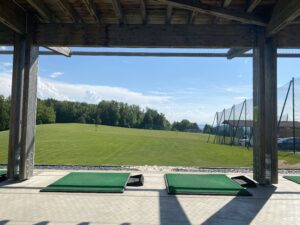
This is especially true on hilly terrain like the driving range and course at Golf du Belvédère, where the changes in elevation put more strain on the shoulders and lower back. The good news is that there's a simple solution. With proper adjustment, better weight distribution, and a bag suited to your skill level, you can walk more comfortably and conserve your energy for playing.
Expert advice: Before heading out on the course, always check the adjustment of your straps when empty: it's the simplest way to avoid fatigue from the very first holes.
Table of Contents - How to carry a golf bag without getting tired?
Remember this in 30 seconds
- Opt for a lightweight bag, especially if you're playing on foot; ;
- preferably use a double strap; ;
- Adjust the bag so that it rests high and close to your back; ;
- Distribute heavy objects in the center; ;
- pack fewer things "just in case"; ;
- maintain an upright posture while walking; ;
- If you experience persistent discomfort, proceed to the trolley without feeling guilty.
What is the best way to carry a golf bag?
The best way to carry a golf bag is like a technical backpack, not a heavy load slung across one shoulder. The bag should stay close to your back, not swing with every step, and distribute the weight evenly between both shoulders.
Your goal isn't simply to carry your clubs. Your goal is to walk for a long time without getting unnecessarily tired. As soon as the pack hangs too low, pulls you backward, or forces you to bend over, it starts to cost you energy, stroke after stroke.
A good carrying system makes walking smoother and helps you stay relaxed before playing. A bad carrying system, on the other hand, makes you lose comfort even before your first shot.
One-strap or two-strap bag: which to choose?
For regular walking on the trail, a double strap is generally the best choice. It distributes the load better between both shoulders, stabilizes the pack, and reduces asymmetrical strain on the back.
A single strap might be suitable if you're carrying a very light bag over a short distance, for example, between the driving range and the first tee. However, for most recreational golfers who walk 9 or 18 holes, a double strap remains the most comfortable solution for carrying a golf bag over longer distances.
- If you walk often: opt for the double strap.
- You play with very little equipment: a simple strap may suffice.
- If you're a beginner: start with a stable and easy-to-configure solution.
- You are already feeling tension on one side of your back: avoid prolonged asymmetrical carrying.
To choose a bag suited to your activity and body type, you can also ask for advice from Golf Pro Shop in Annecy, or consult our guide for Choosing the right golf bag.
How to adjust the straps to carry a golf bag without pain?
A poorly adjusted bag can quickly become uncomfortable, even if it's light to begin with. The straps must be adjusted so that the bag sits high on your back, without hitting your hips or pulling you backward.
The weight should remain close to the body. A bag that's too loose swings around, strains the shoulders, and forces you to compensate with your upper back. With a double strap, both shoulder straps should support the load evenly, without one shoulder working harder than the other.
- The bag should not hang too low on the lower back.
- He must not walk to one side.
- You must be able to walk straight without shrugging your shoulders.
- The bag should be easy to put on and take off between two holes.
Taking ten seconds to check these settings before you leave often saves you real fatigue over the course, especially over long distances between holes.
What weight should I aim for when carrying a golf bag on foot?
Comfort depends as much on the bag's contents as on the bag itself. A well-prepared bag for carrying a golf bag on foot isn't necessarily the one with the most items, but rather one that contains just what you need for your round. In practice, aiming for a total weight of around 6 to 8 kg once the bag is loaded allows you to walk 9 or 18 holes without experiencing excessive discomfort.
The heaviest items should be placed securely in the center of the bag, without creating an imbalance. The best approach is to eliminate anything you won't need on today's route.
To keep according to your practice:
- your clubs are useful for the game; ;
- a few bullets; ;
- tees and a marker; ;
- a spare glove; ;
- a bottle of water; ;
- light clothing if the weather warrants it; ;
- a small rain accessory if necessary.
Avoid placing this in a bag carried on foot:
- the "just in case" accessories that were never used; ;
- too many balls or tees in reserve; ;
- an unnecessarily bulky water bottle; ;
- several layers of clothing layered on top of each other; ;
- equipment that had been forgotten in a pocket for months; ;
- anything that makes you say "you never know".
To improve your walking and pace before playing, you can also train regularly on the covered practice area at Golf du Belvédère.
What posture should you adopt when walking with your bag?
Even with a good pack and proper adjustment, poor posture will eventually tire you out. The rule is simple: walk straight, relaxed, and at a steady pace.
Avoid leaning forward or compensating with one side of your body. If your gait changes to support the bag, it's a sign of a problem with the adjustment, the load, or the bag model.
- Keep your shoulders relaxed.
- Let your arms move naturally along your body.
- Take steady, smooth steps.
- Check that the bag remains stable without you tensing up.
A good indicator is very simple: if, after a few minutes of walking, you almost forget you're carrying your pack, the adjustment is correct. If you feel a pulling or swaying sensation with each step, adjust it immediately before fatigue sets in.
The most common mistakes that make a bag harder to carry
Choosing a bag that's too heavy for your activity
If you mainly play on foot, a very heavy bag with too many compartments quickly becomes a disadvantage over the 9 holes of the course. The right bag isn't the biggest one. It's the one that suits your actual needs.
The straps are adjusted incorrectly.
A bag that hangs down or pulls backward always ends up becoming uncomfortable. Poor adjustment can turn a good bag into a constant source of strain, hole after hole.
Overloading the bag
Too many objects, too many accessories, too many clothes, too many "maybes". At the end of the game, you're mostly carrying unnecessary weight.
Always wear on the same side
Habitually carrying a golf bag on the same side can eventually tire your shoulder and upper back. The discomfort doesn't always appear immediately, but it often develops over the course of several rounds.
Ignoring the body's signals
If you experience recurring pain or unusual fatigue, don't push yourself. The problem doesn't necessarily stem from your physical condition; it could simply be due to an incorrectly worn or adjusted bag.
Which bag should you choose based on your player profile?
You're a beginner
Choose a lightweight, stable, and easy-to-use bag with a comfortable double strap. You don't need an overly loaded model, but rather a bag that helps you play more easily from your very first games.
Do you often play on foot?
Look for a proper carrying bag, well-balanced, designed for walking, with a good shoulder strap system and a reasonable weight. This is the factor that most significantly impacts your comfort on 9 or 18 holes, especially on a course with elevation changes.
You mostly play in a chariot
In this case, carrying comfort becomes less of a priority. You can focus on packing and organizing the bag, while still maintaining a minimum level of comfort for when you do need to wear it. Our guide for choose a golf cart details the compatibility criteria between bag and trolley.
Do you already have back or shoulder pain?
Using a cart is not an admission of weakness. It is often the smartest decision to preserve your energy and enjoyment of the game over the long term.
If you're a complete beginner, you can also discover a free golf initiation in Annecy to learn the right techniques from the start, including the correct way to wear your equipment.
Should you carry your golf bag or use a trolley?
Carrying your golf bag can be very pleasant if your model is lightweight, well-adjusted, and suited to your playing style. This provides a real sense of freedom on the course and simplifies movement between holes.
However, if you're playing on hilly terrain, if you have a physical weakness, or if you tire too easily, a golf cart often becomes the best solution. The right choice isn't necessarily the most daring one; it's the one that allows you to play better and fully enjoy your game.
Ultimately, carrying a golf bag remains first and foremost a personal choice, to be adapted to your physical condition, your course and your playing objectives.
Conclusion: Carrying your bag in the best conditions
Carrying a golf bag without getting tired is no mystery: a suitable bag, properly adjusted straps, and a lighter load are all it takes to transform your comfort on the course. The key principle to remember is simple: in this endurance-intensive sport, golf golf, A well-fitted and properly carried bag is better than an overloaded bag that slows you down from the first bumps.
Want to test these tips in real-world conditions? Come try out your equipment in the covered driving range and on the 9-hole course at Golf du Belvédère, or visit the ProShop for personalized advice on your bag and straps.
FAQ: How to carry a golf bag without getting tired?
How to properly adjust a golf bag to avoid back pain?
Adjust the straps so the bag sits high on your back, without hitting your hips or pulling you backward. The closer the load is to your body, the less strain is placed on your shoulders and back while walking.
Should you carry a golf bag on one shoulder or two?
It's best to distribute the load across both shoulders with a double strap, especially if you're walking several holes in a row. The load is better balanced and the risk of asymmetrical strain is significantly reduced.
What is the maximum weight for a bag carried on foot?
A bag carried on foot should remain as light as possible, ideally between 6 and 8 kg when loaded. Only keep the equipment you truly need for your game to avoid straining your shoulders, back, and trapezius muscles.
How to avoid back pain on the course with your equipment?
Distribute the weight evenly in the bag, maintain good posture while walking, avoid overloading the bag, and choose ergonomic shoulder straps. If pain persists despite these adjustments, a trolley remains a reasonable option.
What type of bag should I choose if I'm walking the route?
If you walk regularly, the best choice is usually a lightweight carrying bag with double straps and comfortable shoulder straps, designed specifically for walking rather than for storage.
Is a trolley always preferable to carrying on the shoulder?
No, it depends on your physical condition and the type of bag you carry. If your bag is lightweight and properly adjusted, carrying it on your shoulder is perfectly comfortable; if you experience recurring discomfort, a trolley becomes the most sensible solution.