How does a round of golf unfold on a course?
A round of golf always follows the same logic, hole after hole, regardless of the player's skill level. Here are the 6 steps that structure each hole of a golf course:
- The start (tee) : each player hits their first ball from the starting area of the hole, respecting the order of play (the player with the best score on the previous hole plays first).
- The game towards the fairway : the following shots aim to progress towards the green while avoiding the rough, bunkers and water hazards.
- The approach : as you approach the green, the shots become more precise to place the ball as close as possible to the flag.
- Putting : once on the green, the player putts until the ball goes into the hole.
- The count of the blows : each stroke played, including penalties, is counted to establish the score of the hole.
- Passing to the next hole : the players move together towards the next hole, respecting the pace of play of the group behind them.
This sequence is repeated on all the holes of the course, whether it is a 9-hole course like the one at Golf du Belvédère or a classic 18-hole course.
Areas of a golf course to know before playing
Before starting on the course, it is useful to know how to recognize the different playing areas, as each one requires a different strategy.
The departure (tee) is the area delimited by two colored marks, which must never be crossed when striking. fairway is the strip of short-mowed grass that connects the tee to the green: it's the most favorable area for improving your game. rough This refers to the longer, denser grass bordering the fairway, making subsequent shots more difficult to control. bunkers These are sandy areas, which must be avoided or played with a suitable club (the wedge). green is the area of short grass surrounding the hole, reserved for putting. Finally, the water obstacles (ponds, streams) result in a penalty of one stroke if the ball ends up in them.
Understanding these zones not only allows you to better choose your club for each shot, but also to respect the rules of course maintenance, such as never walking in a putting line or filling your divots on the fairway.
What are the basic rules to follow on a golf course?
Beyond the scoring rules, a golf course imposes a code of conduct called etiquette, essential for the safety and comfort of all players.
The main rules to know before playing are as follows: never hit a ball until the preceding group is within range, remain silent and still while another player is about to hit, repair ball impacts on the pitch mark and refill divots on the fairway, rake bunkers after passing through them, and let faster groups pass when the game is running late.
These rules, often grouped under the term "golf etiquette," are detailed in our dedicated article: Golf etiquette: the codes to know before you play. They form the basis of golf etiquette, as important as the technique itself to be well received on a course.
What do you need to know before playing golf for the first time?
Playing your first round on a course can be daunting, but a few pointers are enough to approach this moment calmly.
It is recommended to arrive at least 30 minutes before your tee time to warm up on the driving range and check your bag. Clothing must adhere to the club's dress code (no jeans, appropriate footwear), and the minimum equipment includes a set of clubs, balls, tees, and gloves. For your first round, it is advisable to play with experienced players or an instructor, choose an advanced tee (yellow or red tees) to limit the difficulty, and don't hesitate to pick up your ball after a reasonable number of strokes if the hole is taking too long, so as not to slow down the game.
Many golf courses, such as Golf du Belvédère, offer guided rounds or introductory packages allowing you to discover the game on the course in a reassuring environment, before playing in complete autonomy.
Practice or course: what's the difference for making progress?
The driving range and the course serve two complementary purposes in learning golf. The driving range is a training area where you repeat the same shot without the pressure of scoring, solely to work on your swing technique. The course, on the other hand, provides a realistic playing situation: each shot has an impact on your score, club selection depends on the terrain, and mental game management becomes just as important as technique.
A beginner would be wise to alternate between the two: consolidate their basics at the practice range, then gradually apply them on the course, hole by hole, to learn how to manage pressure and read the game in real conditions.
How long does a round of golf last on a course?
The duration of a round depends directly on the number of holes played and the number of players in the group. On a 9-hole course like the one at Golf du Belvédère, a round generally lasts between 1.5 and 2.5 hours for a group of two to four players. On a classic 18-hole course, you should allow between 3.5 and 4.5 hours. To learn more about the differences between these two formats, see our article. Golf course distance: 9 holes vs. 18 holes details the differences in distance and playing time between the two configurations.
The 9-hole format, which is faster to play, is particularly suitable for beginners and players with little time during the week, while still offering a true course experience.
What equipment do you need to play on a golf course?
The equipment needed to play a full round on a course remains simple, even for a beginner. A set of clubs suited to the player's level (often a half set of 5 to 7 clubs is enough to start), a sufficient number of balls to anticipate losses in the rough or water hazards, tees for the drives, a glove to improve grip, and a golf bag to carry everything throughout the course.
The choice of clubs depends directly on the course being played: on a compact 9-hole course like Belvédère, a mid-iron (7 or 8) and a wedge are often sufficient for most approach shots, while a driver remains useful for longer drives. Beginners would be wise to rent or borrow equipment for their first few outings, before investing in their own equipment once their swing has stabilized.
9 holes or 18 holes: which format should I choose to play?
The choice between a 9-hole and an 18-hole course depends primarily on the time available and the player's skill level. The table below summarizes the main differences to be aware of before booking your tee time.
| Criteria | 9-hole golf course | 18-hole course |
|---|
| Average duration | 1:30 to 2:30 | 3:30 to 4:30 |
| Recommended audience | Beginners, players in a hurry | Experienced players, competitions |
| Walking distance | approximately 3 to 5 km | approximately 8 to 10 km |
For a first experience on the course, the 9-hole format allows you to experience the entirety of a round (tee, fairway play, approach, putting) without the physical and mental fatigue of a full 18 holes, which often makes it the ideal entry point.
Play on the Belvédère Golf Course in Annecy
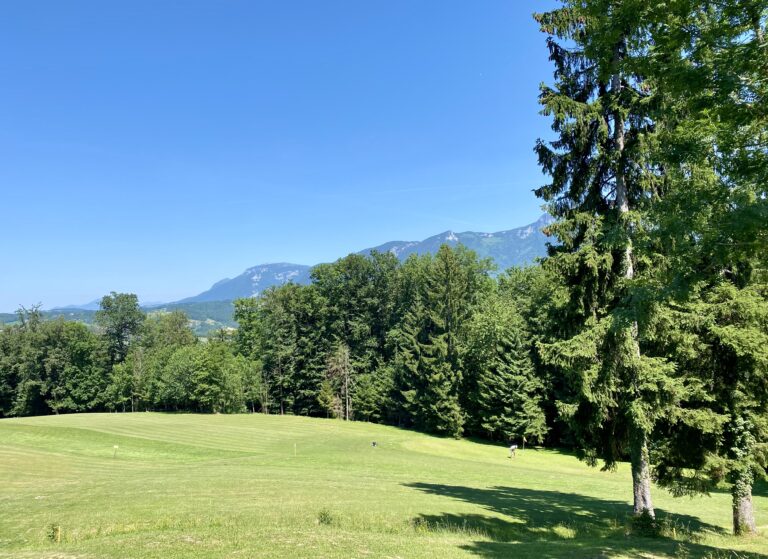
At the Belvédère Golf Course, located in Saint-Martin-Bellevue in Haute-Savoie, the 9-hole course, It offers a course accessible to beginners as well as experienced players, with an unobstructed view of the Aravis and Mont Blanc mountain ranges. From both the driving range and the course itself, it's clear that players new to golf progress faster when accompanied by a state-certified instructor, particularly through the...’Belvedere Golf School, which offers packages adapted to all levels.
The Belvédère course has been designed to allow a reassuring first playing experience: the advanced tees, the moderate size of the 9 holes and the educational support make it a choice course to play your first real round on a course, before embarking on longer formats.