Playing a fade in golf: adjustments, exercises and strategy to master this trajectory
In summary: A fade in golf involves intentionally and deliberately producing a slightly curved trajectory from left to right (for a right-handed golfer). The ball starts on the target or slightly to the left, then gently curves back to the right. Centered contact, a smooth curve, and consistent distance—it's the exact opposite of a slice.
Playing a fade in golf is one of the most useful trajectories that a golfer an amateur can add to their repertoire — provided they understand what produces it, and no longer suffer from it.
You hit balls consistently. You know the theory. And yet, on the course, that ball that goes right and never comes back costs you strokes week after week. Most amateur golfers see this as a swing problem. Sometimes it is. But often, the solution is simpler: learn to transform this movement into a deliberate, consistent fade that's actually useful on the course.
The fade isn't a lucky slice. It's a precision shot. And like any precision shot, it's built with the right reference points — not by hoping it will sort itself out.
This guide provides you with the complete method:
- exact definition,
- self-diagnosis in 60 seconds,
- Address adjustments, targeted practice drills,
- How to use the fade intelligently to lower your score.
Table of Contents - Playing a Fade in Golf
What does it mean to play a fade in golf?
A fade in golf involves producing a slight sidespin that curves the ball from left to right for a right-handed golfer, or from right to left for a left-handed golfer. It's an intentional trajectory, resulting from a precise adjustment of the clubface and club path at impact.
A well-executed fade is recognizable by three essential characteristics: the curve is smooth and controlled (never a banana), the ball maintains its speed and height all the way to the green, and the impact is centered or very close to the center of the clubface. It is this trio that distinguishes a fade from a disguised slice.
The fade is one of the most frequently used shots among professional golfers due to its reliability and repeatability. Jack Nicklaus considered it his signature shot. And contrary to popular belief, it's one of the most accessible shots for amateurs who understand the mechanics behind it.
Fade or slice: the difference that changes everything
This is the most common mistake made by amateurs. Both trajectories start to the right. But everything else is different — and it is precisely this difference that separates a useful shot from a penalizing one.
| Criteria | Fade (controlled) | Slice (subjected) |
|---|---|---|
| Curve | Gentle and moderate | Strong and uncontrolled |
| Contact | Center | Frequent heel |
| Departure direction | Target or slightly left | Often on the right |
| Distance | Stable, slight loss possible | Significant loss |
| Dispersion | Reduced and predictable | Large and unpredictable |
If your ball starts to the right and continues to curve even further to the right: it's not a fade. It's a push-slice. And the solution isn't to adjust your stance—it's to first stabilize the clubface and the initial direction before attempting to create a curved trajectory.
To delve deeper into the topic of trajectories: Difference between draw, fade and hook in golf.
Self-diagnosis in 60 seconds: what kind of move are you really making?
Before attempting a fade, precisely identify what you are producing after each stroke. Read the starting direction, then the curve observed in flight.
| Departure | Curve | Diagnosis |
|---|---|---|
| Left of the target | Gentle to the right | ✅ Fade — continue |
| On target | Slightly right | ✅ Neutral fade — a good sign |
| Right side of the target | To the right | ⚠️ Push-slice — correct the start |
| Left of the target | No curve | Pull — face closed relative to the target |
| Left of the target | Very strong right | ⚠️ Slice — face too open |
This chart helps you avoid the number one pitfall for amateurs: changing the alignment when the problem lies with the clubface, or changing the clubface when the problem lies with the club path. Reading the tee shot and the curve separately is the foundation of any effective diagnosis.
Also read: Why does my golf ball go right?.
The mechanics of the fade: club path and facing the impact
The fade results from a precise relationship between two measurable parameters: the club path and the clubface orientation at impact. It is this difference—called face-to-path—that creates the lateral spin responsible for the curve.
For a right-handed golfer, a clean fade requires two simultaneous conditions: the clubface is slightly open relative to the path (not relative to the target), and the path is slightly outside-in. The ball starts in the direction of the clubface, then curves in the direction of the clubface/path gap.
The classic mistake is trying to "cut" the ball with your hands, or exaggerating the outside path to force a curve. Both approaches produce a desynchronized clubface, degraded contact, and—more often than not—a slice rather than a fade. The goal is to create a small, controlled, and repeatable difference between clubface and path, without tension in the arms or compensation in the swing.
The settings at the address to produce a fade
Here are four adjustments to test on the practice range. Address them one by one — not all at once — and observe the effect on your ball launch before going any further.
1. Body alignment
First, point the clubface towards the target. Only then, align your feet, hips, and shoulders slightly to the left of the target for a right-handed golfer. This open stance naturally creates an outside-to-inside swing path without you needing to think about it during the swing.
2. The ball position
For mid and short irons, position the ball slightly center-left in your stance. For the driver, maintain a standard forward stance and avoid bringing the ball too far forward, which would close the clubface at impact.
3. The grip
Maintain a neutral grip. An overly aggressive grip—with your left hand turned sharply to the right—promotes a natural clubface closure and makes it difficult to produce a fade. If your ball never slices, check your grip first before changing your alignment or swing.
4. The intention of swinging
The most effective intention is the simplest: finish your swing with your hands ending to the left of the target. No need to think about twelve technical positions. A balanced finish, torso turned, weight on the front leg—and let the fade happen naturally.
Expert advice: At the Belvédère Golf driving range, our instructors frequently observe players attempting a fade by exaggerating their stance opening. The result: an overly steep swing path, heel strike, and a slice instead of the desired fade. Start with a modest stance opening—5 to 10 degrees—then adjust based on the observed ball flight.
3 exercises to build a consistent fade
Exercise 1 — The Visual Door
Place two alignment sticks on the ground: the first pointing towards the target (your face line), the second slightly to the left (your body line). Swing along the line of the second stick, with the face pointing towards the first. Hit ten balls, aiming for a gentle curve—not a spectacular spin. If the ball veers sharply to the right, bring the face closer to the target before making any other adjustments.
Exercise 2 — The starting line
Choose a tree or post 8 to 10 meters in front of you as a reference point. Your goal is for the ball to start at this object, or slightly to its left, and then curve gently back to the right. If the ball starts well to the right of your reference point, you have a push—correct the starting direction first before looking for the curve. The starting point is the most reliable indicator of your clubface orientation at impact.
Exercise 3 — The heel contact-resistant towel
Place a folded towel or headcover just outside the ball line, slightly behind it. If you touch the obstacle, your swing path is coming too far outside and you risk heel contact—precisely the type of contact that turns a fade into a slice. This drill simultaneously corrects both the swing path and the quality of contact, without you needing to think about the mechanics during the stroke.
How to play a fade with the driver
The driver amplifies everything: the curve, the effect, and the mistakes. A driver fade is built with smaller, not larger, adjustments — and by absolutely avoiding the two most common mistakes.
Mistakes to avoid: Opening the clubface wide AND aiming to the left — you're creating the conditions for a big slice. Searching for the curve with your hands — you lose control of the clubface at the precise moment you need it most.
The most effective and safest driver setup: face towards the target, stance slightly open, tee at normal height. Swing with your body, without forcing your hands to hold back or cut. Your priority is first and foremost a controlled drive — the curve will then come naturally.
Recommended progression: first master the fade with a 7-iron, then a 5-iron, then a hybrid. The driver is the last step — not the first.
4 situations where playing a fade wins you strokes
The fade isn't a shot to play every time. It's a tactical tool to use at the right time, on the right holes, in the right conditions. Here are four situations where it can actually save you strokes.
- Play with obstacle on the left: Bunkers, out of bounds, water — a fade allows you to aim for the center and naturally secure the right side of the fairway without unnecessary risk.
- Dogleg to the right: The fade curve naturally follows the shape of the hole, allowing you to play with the course rather than against it.
- Flag to the right of the green: A fade approach arrives smoothly on the flag side, brakes better on landing and gives less roll than a draw on this type of position.
- Wind from left to right: A controlled fade is more stable than a draw, which can be amplified by the wind and end up out of bounds.
Also read: strategy on a golf course.
Practicing the fade at Golf du Belvédère Annecy
The fade is quickly built up with the right reference points — but without external feedback, mistakes are repeated and reinforced until they become automatic and difficult to correct. This is where the training environment makes all the difference.
At Golf du Belvédère in Saint-Martin-Bellevue, ten minutes from Annecy, our state-certified instructors—Julien and Damien—regularly work with players of all levels to improve their ball flight. With just a few shots on the driving range, they can identify if your swing curve is due to an outside path, a clubface that doesn't close at the right moment, heel strike, or an incorrectly positioned grip.
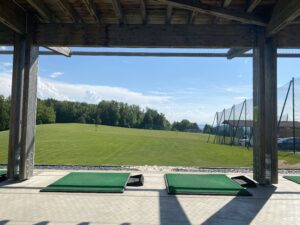
The Belvédère driving range—a unique feature in the Annecy region—offers 250 meters of driving range, grass areas for a feel close to the real course, and a synthetic green for practicing your approach shots. And if you want to test your fade in real conditions immediately after your practice session, the official 9-hole course awaits you just outside the driving range.
Expert advice: During your practice session, don't aim for a perfect fade on your first shot. Start by observing your natural drive over ten balls. Your current trajectory is your starting point—not your problem.
Conclusion: the fade, a tool to be built — not a trajectory to be endured
Many golfers unknowingly hit a fade and have been trying to correct this trajectory for years. The real question isn't whether you're hitting a fade—it's whether that fade is intentional, consistent, and used at the right time on the course.
With the right address settings, two or three targeted practice drills, and a clear understanding of face/path mechanics, the fade becomes a tactical weapon that reduces your double faults, secures your tee shots, and helps you gradually lower your score.
And if you want to go faster: a session with a teacher at Golf du Belvédère will give you in less than an hour the precise answers that several weeks of training on your own do not always give you.
Your fade might be two settings away from being a real asset — not a flaw.
FAQ: Playing a fade in golf
What does it mean to play a fade in golf?
A fade in golf involves intentionally and with control, producing a slightly curved trajectory from left to right for a right-handed golfer (right to left for a left-handed golfer). The ball starts on the target or slightly to the left, then gently curves back to the right with a slight sidespin. The fade is distinguished from the slice by its gentle curve, centered contact, and consistent distance.
What is the difference between a fade and a slice in golf?
A fade is intentional: the curve is gentle, the contact is centered, and the distance remains consistent. A slice is unintentional: the curve is sharp, the contact often hits the heel, and the distance drops. If your ball starts to the right and continues to curve even further to the right, you have a push-slice—not a fade. The solution isn't to adjust your stance, but to first stabilize the clubface and the direction of your shot.
How do I adjust my address to produce a fade effect?
Three adjustments are all it takes: point the clubface toward the target, align your body (feet, hips, shoulders) slightly to the left of the target for a right-handed golfer, and maintain a neutral grip. The swing should follow the body line, creating a slight outside-to-in path. Test one adjustment at a time—not all at once—and observe the ball flight.
Does the fade make golfers lose distance?
A slightly open fade can reduce distance by a few yards compared to a draw, due to higher sidespin and a slightly higher ball flight. Conversely, a controlled fade improves consistency, reduces dispersion, and avoids out-of-bounds shots—more than making up for it on the overall score. It's better to lose 5 yards and stay in the fairway.
How do you play a fade with the driver without it turning into a slice?
Two mistakes to avoid: opening the clubface too wide by aiming far left (which amplifies the slice curve), and trying to cut the ball with your hands (which causes you to lose control of the clubface). The safe setup: clubface facing the target, stance slightly open, swing with your body without forcing your hands. Master the fade first with the 7-iron, then the 5-iron, then the hybrid—the driver is the final step.
When is the fade to be used on a golf course?
The fade is particularly useful in four situations: on a tee shot with an obstacle to the left, on a dogleg to the right to follow the shape of the hole, when the pin is positioned to the right of the green for an approach shot that slows down well, and in a left-to-right wind to stabilize the trajectory. It's a control shot that protects the score rather than maximizing it.
Can you learn to play fades without lessons?
Yes, it's possible to improve on your own at the driving range with the right tools: two alignment sticks, an intermediate target at 8-10 meters, and ten balls per set while observing the tee shot. However, without external feedback, it's common to make the wrong adjustments. A session with a certified instructor at Golf du Belvédère allows you to identify the exact source of the problem in just a few minutes and avoid weeks of errors on your own.