Master your golf approach shots: types of shots, club selection, technique and drills
Approach shots in golf are shots played between 20 and 100 meters from the green to bring the ball closer to the flag and prepare for a short putt. It's the most frequent shot in a round and the most beneficial to practice.
- When chosen and executed correctly, approaches in golf can turn a double bogey into a par, without requiring more distance off the driver.
This guide details the 4 types of approaches in golf, the choice of club according to distance, basic technique and a concrete training plan to progress quickly.
Expert advice: Always aim for a landing zone rather than the flag; the size of a towel is sufficient to secure the majority of your approaches.
Table of Contents - Golf Approaches: The Complete Guide to Saving Shots Around the Green
Why working on your approach shots in golf changes your score
Between 20 and 60 meters, at the edge of the green, in the rough, or behind a bunker: approach shots occur on almost every hole. Analysis of playing strategy (the "strokes gained" method, popularized by statistician Mark Broadie) shows that high-handicap golfers lose the most strokes to higher-ranked players on shots of less than 100 meters—well before the driver.
Most big holes result from a chain of poor approach shots → missed chips → two putts. Securing the approach breaks this chain. And unlike driving, this shot is decided primarily by decision-making (type of shot, club, landing zone) rather than pure power.
It is also the most accessible stroke to work on without being an athletic player: a short and repeatable swing, combined with a good reading of the green, is enough to gain several strokes per round, regardless of your starting level.
The 4 types of golf approaches to master
1) The’rolling approach — the most profitable for an amateur. Little flight, lots of roll. Choose it as soon as the green is clear in front of you, with no obstacles to overcome. Less timing, less risk: think "a slightly longer putt with a short flight.".
2) The’approach lifted — the standard to know. Medium flight, moderate roll. Useful for clearing a slight obstacle or aiming for a flag in the center of the green, with a sand wedge, gap wedge or pitching wedge depending on the distance and the lie.
3) The’lobbed approach — Useful, but not plan A. Lots of flight, quick stop, but it's the most timing-dependent shot. Reserve it for a short pin with little green in front, and only from a clean lie (fairway or light semi-rough).
4) The bump and run — a technical roll, low trajectory and very regular contact, particularly effective in strong winds, on fast greens or in links conditions.
The golden rule: Ask yourself 3 questions before playing — can I roll? Do I have an obstacle to get over? Do I have little green? The longer the ball stays on the ground, the lower your dispersion.
Which club to choose based on distance and riding
The choice of club depends primarily on two factors: the remaining distance and the proportion of ball flight to roll that the situation allows. The table below provides starting point guidelines, which should be adjusted according to your equipment and the firmness of the green that day.
| Club | Approximate distance | Path | Rolled | When to use it |
|---|---|---|---|---|
| 9-iron / Pitching wedge | 20–40 m | Low | Long | Clear green, no obstacles |
| Pitching / Gap wedge | 30–60 m | Average | Moderate | Slight obstacle, flag in the center |
| Sand wedge | 15–40 m | High | Short | More vertical exit, clear obstacle |
| Lob wedge (58–60°) | 10–25 m | Very high | Very short | Few greens, only from a clean lie |
Common pitfall: Reflexively using a sand wedge for every approach shot results in tops and thin shots. A 9-iron or pitching wedge often makes the shot simpler and more consistent, as it requires less precision in the depth of contact.
Situation analysis: lie, green, flag
The lie conditions the choice of shot: on fairway or short grass, all options are open; in semi-rough, favour the lift; in thick rough, avoid the roll and look for a more vertical exit with the sand wedge; on a buried ball, the objective becomes simply to put the ball back on the green, not to get close to the flag.
The green influences the landing zone: uphill, the ball rolls less; downhill, aim for a wider area; on fast greens, reduce the landing zone; on slow greens, the bump and roll becomes even more profitable.
Finally, adapt to the position of the flag: on a short flag, aim for a safer area rather than the pin; at the back of the green, the putt is often the best option; near an edge, play in the center to secure your shot.
Distance technique and control
For consistent contact: feet slightly apart, narrow stance, 60 to 70% of weight on the front leg, ball in the middle or slightly behind the stance, hands slightly ahead of the ball, clubface fairly square (only open it if you know exactly why). The stroke should remain a short, consistent swing—calm wrists to avoid a flip, torso rotating like a mini-swing, same tempo on the backswing and downswing. Key point: finish with your chest facing the target, even on a very short shot.
For distance, two complementary methods work well: the flight/roll formula (a more closed club like an 8 or a 9 gives less flight and more roll; a more open club like a PW or a SW gives the opposite), and the "3 swing lengths" method — short (hands at ankle), medium (hands at knee), long (hands mid-thigh) — combined with only 2 or 3 clubs to cover a wide range of distances without forcing or multiplying adjustments.
Strategy, common mistakes, and field tips
On an approach shot, the goal is not to aim for the flag but a realistic landing area — the size of a towel — which leaves an uphill putt and avoids risky areas (short bunker, thick rough, extreme slope).
The most frequent mistakes among amateurs: always taking the sand wedge, aiming for the flag rather than an area, using the wrists too much (tops and scrapes), moving the weight back on the backswing, looking at the flag at the moment of contact rather than the ball, changing technique with every ball, or playing a lob shot from a bad lie.
Some useful landmarks on the course: on a dubious lie, fly the ball a little higher to get it out cleanly; in the wind, favour the roll or the bump and run (low trajectory, less sensitive to gusts); in case of stress, prioritize the quality of contact above all; and always keep the same routine (a practice swing, a look at the landing zone, then the swing).
Golf approach drills (20 minutes, quick results)
These three exercises take about twenty minutes to complete in a small-game training area and each targets a specific skill: accuracy, distance calibration, and pressure management.
- Landing circle — Place a target area (towel or circle) and play 10 balls; the goal is for 7 out of 10 balls to land in the area. This works on the accuracy of the landing point.
- Distance scale — Play 5 balls at 5 different distances (10, 15, 20, 25, 30 m) while maintaining the same swing length and changing clubs. Practice calibration.
- One ball, one score — Play an approach shot then putt to the hole: 2 points for an up & down putt, 1 point for a maximum of 2 putts. This develops pressure management skills under course conditions.
Find the details of these exercises, and four additional variations, in our dedicated article on 7 golf approach drills to improve quickly.
Where to effectively practice your golf approach shots
The quality of your practice is just as important as its duration. Choose an approach area that replicates real green conditions: slope, varying grass height, and ideally a nearby bunker to practice different situations. On the driving range, consistently alternate distances rather than repeating the same shot over and over: variety builds the ability to adapt on the day of the round.
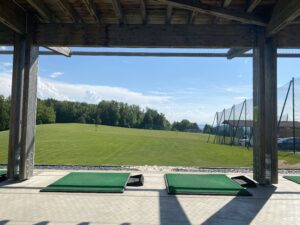
The Belvedere Golf practice has a dedicated area for small games, ideal for reproducing these exercises in conditions close to the course before testing them in competition.
4-week progress plan
Week 1: roll approach only, with 2 clubs (9 iron and PW), target contact and landing point — it's the simplest and most profitable shot, it lays the foundations.
Week 2: Addition of the lift approach with PW, GW and SW, objective medium trajectory and controlled roll, to broaden your range when facing obstacles.
Week 3: working on distances and routine with the distance scale and the "one ball, one score" exercise, to transform technique into numerical results.
Week 4: simulation with 10 different configurations, evaluating each time the lie, the obstacle, the landing zone and the club before playing — the objective is to reproduce the real decision-making on the course.
Conclusion: the fastest method to progress on your approaches
To improve your approach shots in golf, remember the essentials: play the simplest shot, favor the bump and run whenever possible, aim for a target area rather than the flag, and practice with a consistent method (3 swing lengths, 2 to 3 clubs). As with all golf disciplines... golf, Consistency is more important than one-off performances. By applying these principles, you will reduce your major mistakes and make your shares much more attainable.
Want to improve your skills under the guidance of a state-certified teacher? Discover the...’Belvedere Golf School and book your next lesson.
FAQ: Golf Approaches: The Complete Guide to Saving Shots Around the Green
What is an approach shot in golf?
This is a shot played from a short distance from the green, most often between 20 and 100 meters, to place the ball close to the hole and prepare for the putt. It is generally played with a wedge.
What is the difference between chip, pitch and approach shot?
A chip shot is a low shot with a lot of roll, close to the green. A pitch shot is a high approach shot with little roll. "Approach" is the general term that encompasses all these short shots towards the green.
Which club should I choose for an introduction to golf?
It depends mainly on the distance and the roll desired: 9 iron or pitching wedge to roll, gap wedge for a compromise, sand wedge to go out more vertically, lob wedge only when needed and from a clean lie.
How to effectively train for approach shots in golf?
By working several distances (20, 40, 60, 80 m), varying the wedges and systematically aiming for a landing zone rather than the flag, then observing the roll to adjust the dosage.
What is the most common mistake in a golf approach?
Reaching for the sand wedge by reflex when a roll approach with a 9-iron or pitching wedge would be simpler and more consistent.