

Approach shot in golf: a complete technique for overcoming obstacles and gaining strokes
A pitch shot in golf is a shot played close to the green, most often with a wedge, that sends the ball high enough to clear an obstacle before allowing it to roll only slightly once it lands. It's the most versatile short game shot: safer than a lob, more accurate than a bump and run when a bunker, mound, or thick rough blocks a direct path to the pin.
It's often the best compromise between safety and control for beginners and intermediate players, as it requires less precision than a lob while remaining more versatile than a bump and run. This guide covers: when to choose a pitch shot in golf, which club to use, the most consistent technique, how to handle difficult lies, and drills to help you improve quickly.
Expert advice: To progress quickly, focus on just two wedges (PW and SW) and a clear landing point, rather than on a multitude of clubs.
Table of Contents - The Approach Shot in Golf: A Complete Technique to Overcome Obstacles and Gain Strokes (2026)
What exactly is a take-up shot in golf?
A takeoff shot in golf is a shot played around the green, usually with a wedge, where the ball rises quickly, drops in a high arc, and rolls shortly after impact. The aim is to clear an obstacle—bunker, rough, slope—while bringing the ball to a stop quickly near the flag.
Unlike a roll approach, where the ball spends most of its time on the ground, the lift approach favors flight: the loft of the club does the work, not the strength of the arm.
Lifting vs. rolling vs. lobbing approach: how to choose quickly?
Before discussing the technical aspects, we need to clarify the choice of approach. The three families of approaches are distinguished by their flight-to-roll ratio and their level of risk:
| Situation | The best move to take | Risk level |
|---|---|---|
| Plenty of green, no obstacles | Rolled approach | Weak |
| Minor obstacle to overcome, quick stop desired | Approach raised | Moderate |
| Very few greens or large obstacles | Lobbed approach | Pupil |
A key coaching rule to remember: if you're hesitating between a lift and a lob shot, choose the lift. It's more forgiving of minor contact imperfections and remains the safest bet for most amateurs.
When to play this move? Ideal situations
1) A slight obstacle to overcome
Bunker edge, small mound, light rough at the edge of the green, or false flat that would prevent a roll from holding its line: in these cases, the pitching approach in golf becomes the logical choice.
2) A flag placed in the middle of the green
You have a little room to let the ball roll, but not enough for a pure roll. The lift provides the right balance between flight and roll.
3) A medium lie (semirough, slightly tall grass)
The roll shot becomes unpredictable: the clubface catches the grass in an unpredictable way. The pitch shot, played with a more vertical angle of attack, offers greater consistency.
4) Fast or downhill greens
When the green is fast or slopes towards you, you want to land the ball closer to the flag and limit the roll after impact.
Which club should I choose for a lofted approach shot in golf?
The approach shot is primarily played with the wedges from the bag. The choice of club depends on the desired height and the amount of roll tolerated once the ball has landed.
Recommended clubs for amateurs
- Pitching wedge (PW) : low lift, more rolling, very reliable for medium distances.
- Gap wedge (GW 50-52°) : excellent compromise between height and rolling distance.
- Sand wedge (SW 54-56°) : more height, less rolling, the most versatile choice for an amateur.
- Lob wedge (LW 58-60°) : reserved for situations where the ball needs to be stopped very quickly, and only on a clean lie.
Expert advice: To progress without using too many different clubs, focus your training primarily on two clubs: the PW and the SW. They already cover the vast majority of situations encountered on the course.
If you're unsure about the loft or spacing between your wedges, a fitting will precisely adjust the equipment to your swing rather than guessing. At Golf du Belvédère, fittings are provided exclusively by Adrien. ProShop.
The role of bounce and face opening
The bounce, the angle formed between the leading edge and the sole of the wedge, directly influences the success of a pitch shot in golf. The higher the bounce, the more the club "bounces" upon impact with the ground instead of sinking in—an advantage on a soft lie or in the sand at the edge of the green. On a tight lie, too much bounce can cause the ball to top: a slightly less open face and a more moderate bounce (8-10°) then ensure a more secure contact.
Opening the clubface increases the effective loft and flight height, but reduces the margin for error: the more open the face, the more precise the contact needs to be. For most everyday approaches, a square to slightly open face is perfectly adequate.
Step-by-step technique for successfully hitting a takedown shot in golf
The lift approach resembles a chip, with more loft and a more "sliding" contact under the ball.
The setup: key settings
- Narrow stance, feet slightly turned out towards the target.
- Weight distributed at 60-70 % on the front leg.
- Ball positioned in the middle of the stance, or slightly forward with a sand wedge.
- Hands slightly in front of the ball, but less so than on a bump and run approach.
- Club square face, only open if you know why (obstacle very close, need to stop immediately).
The movement: regularity above all
- The torso and arms move together, without any isolated "hand movements".
- The wrists remain calm, just enough to prepare the club for the upswing.
- The tempo is the same on the outward and return journeys.
- A slight acceleration travels through the ball: never decelerate at impact.
Reference point to visualize: imagine a "brushing" shot, where the club just skims the grass after hitting the ball, without digging behind.
How do I handle this hand from a difficult lie?
The technique changes slightly depending on the quality of the lie, and this is often what distinguishes a regular player from a player who is at the mercy of their short game.
- Thick Rough : slightly increase the intensity of the swing without decelerating, and hold the club firmly to prevent the face from turning when it comes into contact with the long grass.
- Short grass or tight lees The main risk is fine contact. Keep your legs bent, don't try to "help" the ball with your hands, and trust the loft of the club.
- sloping terrain Align your shoulders parallel to the slope. On an uphill slope, the ball will start higher and roll less; on a downhill slope, expect the opposite.
Distance control: where to aim for this type of approach
The common characteristic of regular players is that they aim for a specific landing point rather than the flag itself.
The simplest method: fixed amplitude and dedicated club
Avoid varying several parameters at the same time: choose your club (PW or SW depending on the distance), then use three swing amplitudes (small, medium, large), each associated with a flight distance memorized in training.
The flight/roll logic you need to know
With a pitching wedge (PW), the ball flies lower and rolls more after landing. With a sweeping wedge (SW), it's the opposite: more flight, less roll. Find a spot on the green, often located between one and three meters before the flag, and let the ball finish its trajectory naturally.
Practice your approach shot at the Belvedere driving range
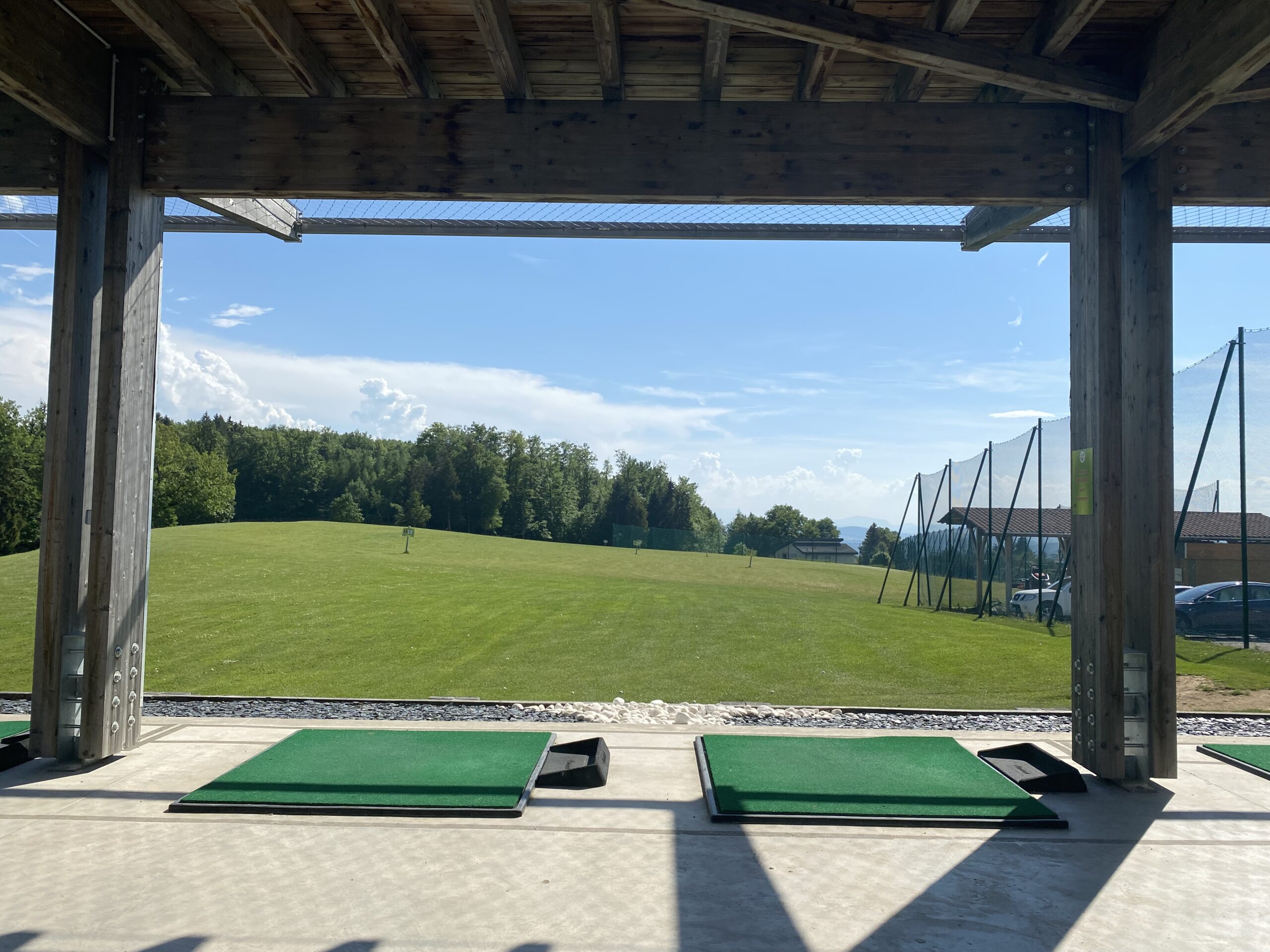
Progress requires repetition in conditions representative of the course. The covered driving range at Golf du Belvédère, spanning 230 meters and several levels, allows you to work on height and consistency all year round, regardless of the weather.
To delve deeper technically, our professors Julien and Adrien offer... private lessons Focused on the short game, with an outside perspective to correct extraneous movements (hand flips, deceleration) that are difficult to perceive on your own. If you are a beginner, the free Sunday morning introductory session, led by Julien, a state-certified instructor, is an excellent way to discover the basics of the short game before moving on to more advanced techniques.
Common mistakes to avoid
- Decelerating on approach to impact, which causes the ball to go short or results in a scraped contact.
- Wanting to "lift" the ball with a wrist movement (flip), instead of letting the loft of the club do the work.
- Changing all the parameters with each shot, without maintaining a stable reference point from one attempt to the next.
- Aim for the flag rather than a landing zone, which reduces the margin of error.
- Always using a 60° lob wedge when a sand wedge would be more than sufficient.
Exercises for rapid progress (15 minutes)
- Three landing zones : Place three targets on the ground (short, medium, long) and fire five shots per target, aiming for the zone, not the flag.
- PW vs SW : from the same distance, play five balls with the pitching wedge then five with the sand wedge, to build your own flight/roll reference points.
- Up & down Follow up with a pitch shot and then a putt, and note your score over ten attempts. This exercise replicates the real pressure of the course.
Conclusion: the approach shot, the Swiss Army knife of the small game
L'’approach lifted In golf, the lob remains the most versatile shot around the green: enough height to clear an obstacle, enough control to score, and less risky than a lob. It is practiced with two main clubs, a clear landing point, and three well-defined swing lengths.
To progress faster, the best option is to practice in real-world conditions. Discover our Golf school and book a private lesson to turn this technique into a reflex on the course.
FAQ: The takeoff shot in golf: a complete technique to overcome obstacles and gain strokes (2026)
What is a take-up shot in golf?
A pitch shot is a shot played around the green, often with a wedge, where the ball rises quickly, drops in a high arc, and rolls very little. The aim is to clear an obstacle and bring the ball to a stop quickly near the flag.
When should you favor a lift approach over a roll chip?
Choose a takeoff approach when you need to get past an obstacle (bunker, raised edge of green, thick rough), when the flag is short with little green available, or when the green is firm and fast and you want to limit the roll.
Which wedge should I use for a lift approach: SW, LW or PW?
The lob wedge (58-60°) is the simplest for combining height and immediate stopping power. The sand wedge (54-56°) offers the best compromise between height and control for an amateur. The pitching wedge provides a lower launch angle and more roll. The choice depends on the lie, the distance, and the amount of green available.
How to manage a raised approach from thick rough?
Increase the swing power slightly to clear the rough without slowing down, and hold the club firmly to prevent the face from rotating at impact. Accept slightly less precise distance control: the primary objective is to clear the rough cleanly.
What is the role of the bounce in a successful fundraising approach?
The bounce prevents the club from sinking into a soft lie or sand. A high bounce secures contact on a difficult lie, while a more moderate bounce is better suited to a tight lie or short grass, where the main risk is a thin contact.
How to train effectively for lift approaches?
Two exercises are particularly effective: drop targets, which consist of placing three zones at different distances and landing the ball in them, and the distance ladder, which consists of playing sets of ten balls at increasing distances with the same club while varying the swing amplitude.


