Golf fitting for beginners in 2026: yes, if you keep it simple
A Golf fitting for beginners It's useful if you keep your focus on the fundamentals: proper length, consistent grip, forgiving clubheads, and a playable driver loft. The goal isn't to optimize your spin down to the degree, but to lay a solid foundation that allows you to progress without compensating for unsuitable equipment.
Expert advice: Fewer variables, more method. A good beginner fitting lasts 60 to 90 minutes and focuses on the fundamental adjustments: length, grip, forgiveness, driver loft.
Table of Contents - Golf Fitting for Beginners in 2026: Yes, if You Keep It Simple
Direct answer: yes, a golf fitting is useful for a beginner.
A beginner golf fitting is useful if it remains focused on the fundamentals: appropriate length, consistent grip, forgiving clubheads and a playable driver loft. The goal isn't to optimize your spin down to the degree, but to lay a solid foundation that allows you to progress without compensating for unsuitable equipment. The real risk isn't fitting too early, it's... fitter without method — by changing too many variables at once, or too late, when your swing has already anchored compensations.
The story we often see in Annecy (and why it matters)
A beginner arrives at the driving range motivated. New bag, desire to do well, and this phrase invariably comes back to him: "I thought I was rubbish."«
We look at the equipment. Driver with little loft, shaft too stiff, standard length, thin grips. The result is predictable: unstable posture, low ball flight, dispersion to the right or left, and the urge to force the shot to compensate.
Then we adjust three simple elements: a more consistent loft, an appropriate length, and a more stable grip. The posture calms, the ball lifts, and dispersion decreases. The player doesn't hit "harder"—they hit "simpler.".
In our region (Annecy/Haute-Savoie), with its bordered fairways, elevation changes, and sometimes chilly conditions, demanding equipment amplifies mistakes. Consistent equipment makes the game playable and maintains motivation—this is often what makes the difference between a beginner who comes back and one who gives up after three months.
When a golf fitting for beginners is relevant
Before booking a session, it is helpful to know in which cases a Golf fitting for beginners It provides a real benefit, and in which cases it's better to wait a few more weeks.
Yes, if you play regularly
The key point: practice at least once a week (practice and rounds combined). If you only play once or twice a month, the benefits of a fitting will take time to materialize, as your progress will be slow.
Yes, if you're buying your first serious series
Many beginners start with a used half-set or generic equipment. If you're investing €500 to €1500 in your first set, a foundation fitting is worthwhile: it reduces the risk of buying equipment that doesn't suit you.
Yes, if you are very tall or very short
There's no one-size-fits-all solution. A golfer who is 1.65 m or 1.95 m tall will play better with clubs suited to their build. It's not a matter of comfort; it's a necessity for a stable posture.
Yes, if you experience pain
Back, wrists, shoulders: often it's not the technique, it's the equipment. A club that's too long or an unsuitable grip can be enough to create chronic compensation.
Yes, if your trajectory is repeatedly unplayable
Ball always too low, extreme dispersion to the left or right, inability to lift the ball: a fitting can identify if it is a problem of technique, equipment, or both.
When to wait before a fitting
Wait if your contact is very random
If you're only hitting one ball correctly out of every two or three, a fitting will struggle to provide reliable recommendations. Fitters base their recommendations on averages, and you don't have an average yet. Take a few lessons first, practice regularly on the driving range for four to six weeks, and then revisit the idea.
Wait if you rarely play
Less than twice a month: you're not practicing enough to justify a fitting. The investment (€400 to €800) is only justified with regular, not occasional, use.
Wait if you are in the middle of a technical overhaul
Has your instructor told you that your posture or rhythm needs to change completely? Stabilize your technique first (8 to 12 weeks), then adjust your equipment. Otherwise, the recommendations will change quickly.
Why fitting is often misunderstood
Many beginners think that a fitting is a luxury reserved for experienced players. This is a mistake: the Golf fitting for beginners Fitting for experienced players and other related processes are two different approaches.
An experienced golfer aims for fine-tuning: gaining a few yards off the driver, reducing spin by 200 revolutions per minute, and fine-tuning the lie angle of the 6-iron to within a degree. A beginner focuses on the foundation: "Does my equipment allow me to play normally, or does it force me to compensate?"«
These are two different worlds. And that's why a good fitting for a beginner is often more useful than a fitting for an experienced player for your progression: you're starting from scratch, every foundation counts.
The Belvedere's covered practice area as a testing ground
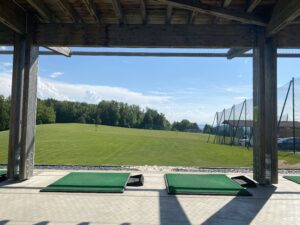
In Annecy, the Belvedere practice It offers a unique feature: it is a covered, multi-level space of 230 meters. Unlike a simple linear practice area, you can test your new equipment in varied conditions, including in the rain or in cool weather, which is frequent in Haute-Savoie for a good part of the year.
This means that if you have a fitting at the club, you can validate your settings immediately, and then move on to the 9-hole course, to confirm your impressions in real playing conditions, on the same day. This is a local advantage: you leave with clubs tested in the conditions of Annecy, not just validated in theory.
Realistic goals for a beginner's fitting
- A more natural and comfortable posture — you feel better at the address.
- More regular contact — fewer topspins and scrapes, more center shots.
- A more playable trajectory — the ball takes off, holds its line, is controlled.
- Less dispersion — more balls in play, fewer losses in the rough or out of bounds.
What a fitting cannot do:
- Correcting your swing technique (that's what the lessons will do).
- Gaining 50 meters with your driver in two weeks (speed comes from the swing).
- Replace regular practice.
The adjustments to prioritize in a golf fitting for beginners
1. Club length (absolute priority)
Length affects your posture, and therefore your consistency. It's the adjustment that changes results most quickly.
- Club too long : curved posture, heel or toe contact, frequent tops, dispersion to the right (for a right-handed person).
- Club too short : you "squash" over, unbalanced center of gravity, frequent scraping, less usable distance.
- Suitable length : stable posture, natural positioning, regular centering.
Simple rule: in the setup, your arms should hang naturally, your hands should end about 15 to 20 cm before your body, above the ball.
2. Grip size (high priority)
The grip is your only point of contact with the club.
- Grip too thin : your hands must grip tightly to stabilize, which strains the forearms and makes trajectories unpredictable.
- Grip too big : it's difficult to relax your hands, your face moves less freely.
- grip suitable : natural grip, easy release, more stable face.
3. Head tolerance (high priority)
When you're starting out, your shots will inevitably be inconsistent—that's normal. More forgiving clubheads (higher inertia, less punishing on off-center contact) help you play faster, rather than frustrating you with every off-center hit. It's not a default choice; it's a smart choice for learning.
4. Driver loft — the most common mistake
Many beginners choose a driver with too little loft (9 to 10°) thinking they will gain distance. This is a common mistake.
The reality:
- A loft that is too low requires a higher swing speed to get the ball airborne.
- A more consistent loft (11 to 13° for a beginner) increases the launch angle, improves carry and makes the trajectory more playable.
- You rarely lose distance; you mainly gain in consistency and confidence.
5. Iron lees (medium priority)
If your irons consistently start to the same side, an incorrect lie angle can exacerbate the problem. This adjustment becomes relevant after you have stabilized the length and grip.
6. Shaft — to be handled with care
A stiffer shaft doesn't automatically mean "better" for you. If it throws off your natural tempo, it will worsen your consistency rather than improve it.
Which club fitter should I get first?
Ask yourself just one question: which club costs you the most strokes over a full round?
| Situation | Club to fit as a priority |
|---|---|
| You lose balls at the start | Driver |
| You scratch or top regularly | iron set |
| You take a lot of three-putts. | Putter |
This approach maximizes your return on score and avoids spending on secondary optimizations.
How does an effective golf fitting for beginners work?
A good beginner fitting follows a simple method: fewer variables, more clarity.
Step 1: Simple diagnosis (10 min)
The fitter clarifies your actual level, your frequency of play, your objectives and your comfort (possible pains, posture preferences).
Step 2: Initial reference (10 min)
The fitter observes your current equipment to establish an average: direction, contact, trajectory, dispersion. Key point: the average is judged, not the best ball.
Step 3: Foundation adjustments (20 to 30 min)
The fitter prioritizes adjusting the length, grip size, head forgiveness, and driver loft if necessary, one variable at a time. Changing length, grip, and loft all at once doesn't allow you to know what changes what.
Step 4: Validation (10 to 15 min)
You hit 10 to 15 balls with the new settings. We look at the average and judge whether it's better, the same or worse than the initial reference.
Step 5: Evolving recommendations (5 min)
You leave with a written summary (length, grip, lie, loft, shaft) and the possibility to refine it later, once your swing is more stable.
Total duration of a good beginner fitting: 60 to 90 minutes.
How much to invest when starting out, without overpaying?
A Golf fitting for beginners doesn't need a premium "full bag" format from the start. The most cost-effective strategy:
- Foundation fitting (€400 to €600) Length, grip, forgiveness, loft driver. Approximately 1 hour, covers the basics.
- Regular practice for 2 to 3 months : you stabilize your swing and identify your real needs.
- Optional refining (200 to 400 €) : after 3 months, a second pass can optimize shafts, lies and putter, once your foundations are solid.
Total cost for healthy progress: €600 to €1000 over 6 months, rather than €1500 all at once.
The most common mistakes made by beginners
These errors often occur during a Golf fitting for beginners They are poorly prepared, and costly in terms of both money and progress.
- Buy a driver with a low loft (9°) "like the pros"«, and then never managing to lift the ball.
- Choosing overly demanding clubs (heads "players", not very tolerant) while the centering is still irregular.
- Choosing a shaft that is too stiff thinking they will gain precision, at the risk of losing their natural rhythm.
- Change equipment after each bad session instead of stabilizing the base.
- Judging a club based on 3 successful shots instead of the average over 15 to 20 strikes.
Conclusion: simple fitting, rapid progress
A Golf fitting for beginners It's useful if you keep it simple: appropriate length, consistent grip, forgiving clubs, and a playable driver. These foundations improve your average, your confidence, and your enjoyment on the course.
Don't confuse two things: buying suitable equipment (which is what a fitting does) and completely changing your swing (which is what lessons do). Both together accelerate your progress; neither can be done without the other.
To deepen your knowledge of the equipment, you can consult the page dedicated to golf club on Wikipedia.
To start playing golf or find local coaching in Annecy, consult our golf lessons adapted to your level or contact our team to arrange your fitting session at Belvedere practice.
FAQ: Golf fitting for beginners
Can a beginner get a golf fitting?
Yes. A beginner golf fitting is useful if it focuses on the fundamentals (length, grip, forgiveness, driver loft) to improve posture, contact, and dispersion. Just avoid fitting too early if your contact is very inconsistent, as the recommendations won't last long.
When is the best time for a beginner golf fitting?
Do this when you play regularly (at least once a week), when you buy your first serious set of clubs, or if your clubs feel uncomfortable. If you rarely hit the ball correctly, take a few lessons first and practice for 4 to 6 weeks.
What settings should be prioritized for a beginner?
Club length, grip size, head forgiveness, and driver loft. These four elements immediately improve posture, stabilize the clubface, and facilitate a playable trajectory.
Which club fitter should I get first when I'm starting out?
The club that costs you the most strokes over a full course: the driver if you lose balls off the tee, the irons if you regularly hit thin or top the ball, the putter if you make a lot of 3-putts.
Do you have to wait until you have an index finger to get a fitting?
No. The real criterion is the frequency of practice, not the official handicap. If you play at least once a week, a foundational fitting is already relevant.
Does golf fitting replace golf lessons?
No. It makes lessons more efficient: with suitable clubs, you compensate less and get clearer feedback at impact, which accelerates technical progress.
How much does a golf fitting cost for a beginner?
A foundation fitting typically costs €400 to €600 for approximately one hour. A more comprehensive fitting can cost €800-€1200. Contact the Belvédère pro shop for current local prices.
Does fitting guarantee rapid progress?
No, not on its own. It improves your equipment foundation, but your progress depends primarily on your regular practice and lessons. Combined with both, a fitting significantly accelerates results.