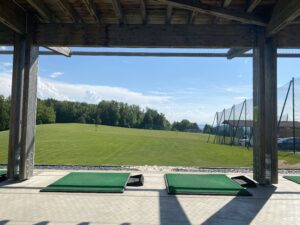
Golf course management: the complete method to score better without changing your swing
Golf course management is the skill that lowers amateur scores the fastest.
You don't need a perfect swing to score better. You need better decisions: club selection, target selection, risk management, hole planning.
For the overall approach and complete plan, also consult our guide:
Table of Contents - Course Management in Golf
What is the best golf strategy for a beginner?
What is course management in golf?
Course management in golf is the art of choosing the right shots at the right time to minimize errors and optimize the score, without changing your swing technique.
In practical terms, this means playing with a simple logic:
Avoid penalties, aim wide, choose the most reliable club, and accept the bogey when it protects your card.
Why course management lowers scores faster than technique
Most lost shots among amateurs do not stem from a lack of talent, but from poor decision-making.
A bad choice turns a normal mistake into a penalty, then into a series of difficult shots.
- Fewer penalties (water, out of bounds, lost ball).
- Fewer double bogeys and disastrous holes.
- More moves played from simple positions.
- Greater consistency, therefore an index that falls faster.
The 5 fundamental principles of golf course management
1) Play according to your dispersion
Your strategy must protect your usual failure rate.
If you frequently miss to the right, your target and your club must allow that miss to be played.
Don't build a plan around your best move, but around your most frequent move.
2) Target areas, not points
Aiming for the flag is rarely profitable if your spread is wide.
The center of the green (or the big side) increases your margin for error and reduces difficult shots.
3) Anticipate the next move
A good move is not just a "successful" move.
This is a shot that leaves you with a simple next shot: good distance, good angle of attack, correct lie.
4) Eliminate the priority hazard
The priority danger is the one that can automatically cost you a shot: water, out of bounds, stray ball.
Your plan should first reduce the likelihood of penalty, even if it means playing longer or more cautiously.
5) Accept the intelligent bogey
A bogey is often a good score to protect your card.
High scores mostly come from heroic moves attempted after an initial failure.
Course management is about limiting the damage when things get complicated.
How to apply hole-by-hole course management
A simple method in 3 decisions:
- Identify the main danger (penalty).
- Choose a wide target that protects your miss.
- Choose the most reliable club to make the next shot simple.
Step 1: Identify the main hazard
Before playing, identify what might automatically cost you a move.
If water or out-of-bounds is on your likely miss, your strategy should move away from it.
Step 2: Choose the broad target
Your target should be an area.
It should remain correct even if you make a slight mistake.
The wider the target, the more stable your score becomes.
Step 3: Choose the most reliable club
The best club is not necessarily the one that goes the furthest.
This is the one that most often puts you at risk.
On many holes, a hybrid or a wood is more cost-effective than an unstable driver.
Explore your initial options further here:
A concrete example of course management in golf
Par 4 narrow with water on the right and long out of bounds.
Your usual miss is a slice (ball that goes to the right).
- Bad strategy: driving "in the center" hoping for the right move.
- Good strategy: hybrid towards an area on the left which leaves the slice playable.
The result: you may have a longer approach, but you avoid the penalty that turns the hole into a double bogey.
Race management in competition
Under pressure, mistakes often stem from a change of plan.
The right approach is to simplify: aim wide, choose a safe club, accept the bogey if necessary.
- More conservative decisions on penalty holes.
- Objective: to avoid a catastrophic hole, not to "achieve a feat".
- A stable routine to limit emotion.
Common mistakes in race management
- Attack all flags, even near danger.
- Ignoring its dispersion and aiming too small.
- Change strategy after a failed attempt.
- Wanting to correct a mistake immediately.
- Copy the strategy of a stronger player.
For a simple plan suitable for high indexes, also read:

Because for us, golf is synonymous with meeting and sharing, at Le Golf du Belvédère you won't just find a fine training facility, you'll also find a soul and an atmosphere...
In short, an ever-smiling welcome that will make you want to extend the sporting experience with a moment of relaxation on the
At The Belvédère Golf Course, just outside d'Annecy you can enjoy a meal with a breathtaking view of the Aravis massif.
You will also find at your disposal some very nice infrastructures such as :
- A multi-level, 230-metre driving range
- A putting green
- An approach area
- A 9-hole course to put your training into practice
- The Annecy Golf Academy with two golf instructors