How to start playing golf on your own: a complete method to progress without a coach in 2026
How to start playing golf on your own? Simply start at the driving range with a 7 iron, follow up with short sessions of 30 to 45 minutes focused on a single objective, then quickly join the course to progress in real conditions.
Regularity, simplicity of exercises and a clear method are the three keys that allow you to progress quickly, even without a teacher.
Many beginners believe that coaching is essential to get started. However, it's not mandatory. At Golf du Belvédère, in Saint-Martin-Bellevue near Annecy, several self-taught players improve every week thanks to the multi-level covered driving range and the hilly 9-hole course, without having taken a single lesson initially.
Expert advice: Never look for distance before you have consistent ball contact with the 7 iron: power will come naturally once the stroke is mastered.
Table of Contents - Starting Golf Alone
This article provides a complete, step-by-step method for learning golf independently: the fundamentals to master, the training routine to follow, the truly useful equipment, and the mistakes to avoid so as not to waste time.
How to start playing golf on your own: the 6 essential steps to progress quickly
- Start at the practice area to learn the techniques without pressure
- Use a single club initially (iron 7) to simplify learning
- Keep sessions short 30 to 45 minutes, but regular
- Working towards a specific goal at each session rather than hitting balls randomly
- Filming your swing regularly to spot its flaws without an outside eye
- Quickly pass by the route to improve in real-world conditions
This method, designed for anyone wondering how to start playing golf on their own, is the one followed by the majority of self-taught golfers who progress quickly. It is based on a simple principle: regular, structured practice is better than long but disorganized training sessions.
Why starting golf alone is often the most effective method
Learning how to start playing golf on your own begins with understanding why this approach works so well. Contrary to popular belief, learning independently can accelerate a beginner's progress. Without an instructor, you're forced to observe your shots, understand why the ball goes right or left, and adjust your swing yourself. This autonomy develops an understanding of the game that few formal lessons impart as quickly.
Golf is a sport of repetition and feel. A player who trains alone, two to three times a week, generally progresses faster than a casual player, even if the latter takes occasional lessons. Here are the main benefits observed in self-taught golfers:
- They play more often because they are not dependent on a class schedule.
- They learn to correct themselves, a skill that will be useful throughout their golfing careers.
- They develop a swing regularity specific to their morphology
- They progress at their own pace, without performance pressure
This freedom, however, has a downside: without external guidance, it's easy to repeat the same mistake for a long time without realizing it. That's why video and careful observation of the ball's trajectory become almost as valuable tools as a teacher for a player learning on their own.
The essential technical basics to get started on your own
Forget about power, look for the right connection
The most common mistake made by a beginner looking for how to start playing golf on their own is wanting to hit hard from the very first sessions.
In reality, the absolute priority is the quality of contact between the clubface and the ball. A slow, controlled swing always produces a better result than a fast but poorly controlled one. This clean contact allows for better ball control, increased confidence, and faster progress in subsequent sessions.
Grip, posture and rhythm: the three pillars of the swing
Three technical elements must be mastered before anything else:
- The grip The way you hold the club determines the trajectory of the ball.
- The posture The balance and position of the body determine the quality of the movement
- The rhythm : a regular tempo limits contact errors
These three fundamentals are the same as those taught in any golf school. The difference when learning on your own is that you work on them at your own pace, without pressure.
The 7-iron, the ideal club for starting out on your own
The 7-iron remains the best club to start with. It offers a good compromise between shaft length and face angle, making it easy to learn the swing without unnecessary complexity. Most beginners get their first good feel for the club with this one before even trying a longer iron or a wood.
The Belvédère Golf driving range: your ideal training ground
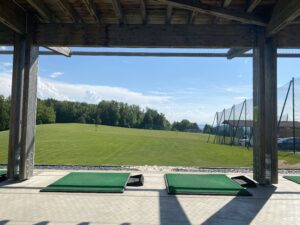
Understanding how to start playing golf on your own also involves making good use of the driving range. Belvedere Golf practice is a valuable ally for progressing independently. With its 230 meters and its covered stations on several levels, it allows training all year round, even in bad weather, a real asset in Haute-Savoie.
To use it effectively when starting out on your own, here are a few simple principles:
- work slowly, without seeking distance
- stay focused on one objective per session
- Don't change clubs with every ball
- Set yourself a clear goal before you begin
The practice area is not a place to hit balls randomly, but a space to repeat a precise movement until it becomes natural.
The 45-minute workout routine that changes everything
The structure of an effective session
An effective routine is essential when looking for a way to quickly start playing golf on your own. A well-structured session always follows the same logic:
- 10 minutes: warm-up and practice swings
- 20 minutes: practice with a specific objective
- 10 minutes: short game (chips, short approaches)
- 5 minutes: putting
This routine allows you to work on the whole game without getting distracted, even when playing solo.
Why this structure works
A short but regular routine structures progress and prevents distractions. It is particularly suitable for those starting golf on their own, as it provides a clear framework for each session, without requiring the presence of an instructor to stay motivated.
How to progress quickly when playing alone
Film your swing to self-correct.
Video remains the most effective tool for a self-taught golfer. It allows them to see their errors in positioning, grip, or rhythm, and to compare their stroke to reliable references. Without this visual feedback, it's difficult to understand why a ball is going poorly.
Get on the course as soon as possible
The Golf du Belvédère course, a 9-hole hilly course with views of the Aravis mountains, is where a beginner truly learns to play. The driving range develops the swing, but only the course develops the player: stress management, club selection, hole strategy. Don't wait until you're "ready" to start; a few holes are enough to improve.
What equipment do I need to start playing golf on my own without breaking the bank?
Equipment is also a common question when considering how to start playing golf on your own. Many beginners think they need a complete set of equipment to get started. This isn't necessary, especially in the first few weeks.
The minimum equipment needed to get started:
- a 7-iron
- a wedge
- a putter,
- a few bullets
With these three clubs, it's already possible to make significant progress, both on the driving range and on your first few holes. The Pro Shop at Golf du Belvédère can also recommend a half-set suitable for beginners for those who wish to invest gradually.
Going further: the free Sunday introductory course, a springboard for self-taught individuals
Good to know: Starting golf on your own doesn't mean you can't benefit from occasional guidance. The Golf du Belvédère offers a [lesson/session] every Sunday. free initiation, Led by Julien, a state-certified instructor, this is the perfect opportunity to check your basics (grip, posture, safety) without obligation, before continuing to train independently.
This free formula perfectly complements a self-taught practice: it allows you to correct a technical flaw that has been present for several sessions, without having to enroll in a complete course of private lessons.
Mistakes that waste the time of self-taught individuals
Certain mistakes regularly occur among players who learn on their own:
- wanting to hit hard before mastering contact
- change technique with each video watched
- following contradictory advice without a coherent method
- never structure your sessions
- to stay only at the practice area, never playing on the course
The main mistake remains the same: learning without a clear method. Solid progress always relies on regularity, simplicity, and a well-defined routine.
Another, more subtle mistake is to pick and choose tips from the internet without any coherent approach: a video on grip one day, another on hip rotation the next. This isolated information often ends up contradicting itself and creating more confusion than real progress. It's better to choose a single method, stick to it for several weeks, and then adjust it as needed, rather than changing everything with each new video you watch.
Conclusion: Take action and start playing golf on your own this week!
Starting golf on your own is a perfectly viable strategy, provided you stay structured. By combining regular practice, a simple routine, and frequent visits to the course, progress is often faster than you might imagine, even without a dedicated instructor.
The golf It remains a sport of patience and repetition, where each session counts more than each isolated stroke. To put this method into practice in a pleasant setting, the The Belvédère Annecy Golf Course Saint-Martin-Bellevue offers a covered practice area, a 9-hole course accessible to beginners, and a free introduction every Sunday to complete your learning independently.
FAQ: How to start playing golf on your own: a complete method to progress without a coach in 2026
How to start playing golf effectively on your own?
Start at the driving range with a 7-iron, string together 30- to 45-minute sessions with a specific goal in mind, and join the course as soon as your ball contact becomes consistent. Progress comes from structured repetition, not the number of balls hit.
Is it possible to learn golf on your own without ever taking lessons?
Yes, it's possible by following a structured method: grip, posture, and rhythm first, then regular practice on the driving range and on the course. A one-off introductory session, like the free one offered on Sundays, is still useful for solidifying your basics without committing to a full course.
Which club should I choose first to start out on my own?
The 7-iron is the best starting point: its length and loft make learning the swing easier. A wedge and a putter are useful additions to this initial set of equipment.
How long does it take to make progress as a self-taught learner?
With two to three structured sessions per week, the first progress usually appears within a few weeks. Consistency is more important than the duration of each session.
Should we start at the practice area or go directly onto the course?
The driving range allows you to learn the stroke without pressure, but you shouldn't stay there too long. Playing a few holes quickly, even imperfectly, develops skills that the driving range alone cannot impart.
How can we know if one-off support is necessary?
If the same technical flaw persists despite several weeks of practice, or if progress stagnates, an outside perspective can resolve the situation. An introductory session or a one-off lesson is often sufficient, without jeopardizing independent learning.