Golf practice range training: the plan to improve in 60 minutes
Good golf practice isn't about emptying buckets of balls, but about leaving with measurable progress: cleaner contact, tighter dispersion, better-weighted wedges, and a routine that holds up on the course.
Expert advice: Note down your three key figures after each session (success rate, feeling, next action): it is this regular monitoring that transforms an occasional practice into real measurable progress.
Table of Contents - Golf Practice Range Training: The Plan to Improve in 60 Minutes
What constitutes a good golf driving range practice session?
The driving range is your laboratory: you can practice, measure, and correct without affecting your scorecard. On the course, you manage the consequences; on the driving range, you build the causes. The classic trap is hitting balls "just for the sake of hitting balls": it's a good way to let off steam, but it doesn't provide any structure.
An effective practice session always follows the same four-step logic:
- You are working on a specific element (contact, distance, trajectory).
- you are measuring a numerical result
- You adjust only one parameter at a time
- you validate in course simulation
This is the approach we recommend to golfers of all levels who come to practice on the covered driving range at Golf du Belvédère.
Before hitting the first ball: choose your objective
A practice session without a goal is like a workout "just to sweat": you leave tired, but you do exactly the same thing the next time. The rule for good golf practice is simple: one measurable goal per session.
Three measurable objectives to choose from
- Dispersion: With 10 balls using a 7-iron, hit 6 balls within a corridor of X meters.
- Contact : to get 7 out of 10 balls hit in the center of the face, with the expected feel and trajectory.
- Wedges: between 30 and 75 meters, place 6 out of 10 balls at a "puttable" distance (2 putts maximum).
The 5-ball rule, versus autopilot
The brain loves to switch into autopilot mode as soon as it repeats a movement. To avoid repeating the same mistake thirty times in a row during a session, apply this simple rule:
- Hit a maximum of 5 balls with the same setting.
- Pause for 15 to 25 seconds.
- Change just one element: the target, the club, the intended trajectory, or the routine.
- Restart the series.
60-minute golf driving range training plan
Here is the framework we recommend for a complete and balanced session, suitable for both beginner and experienced golfers.
| Time | Worked area | Objective | Format | Success criteria |
|---|---|---|---|---|
| 0–5 min | Warm-up | Mobility and rhythm | Empty swings, half-swings | A smooth, effortless feel |
| 5–20 min | Putting and chipping | proximity scoring | 3 targeted exercises | 2 out of 3 exercises completed |
| 20–40 min | Wedges (30–75 m) | Distance control | Distance scale + target | 6 out of 10 shots at a good distance |
| 40–55 min | Irons and hybrids | Dispersion | Club targets and variation | Dispersion corridor respected |
| 55–60 min | Simulation route | Transfer from practice area to course | 6 balls "just like on the course"« | Complete routine and target selection |
If you wish to structure this progression with the help of a professional, the private lessons from the Belvedere Golf School allow progress to be significantly accelerated.
Start with the short game and putting, before the driver
The urge to pull out the driver during warm-up is natural. However, if your goal is to lower your score, the most productive areas are within 100 meters of the green. Starting with the short game allows you to find your rhythm and immediately switch into "quality" mode.
Putting exercise #1: The confidence circle (3 minutes)
Place 6 balls around the hole, 1 meter away. The goal is to get at least 5 out of 6 in. If you get fewer, repeat the set before moving on to the next exercise.
Putting exercise #2: Distance control (4 minutes)
Play 3 putts from 5 meters, then 3 putts from 8 meters. The goal is to avoid 3-putting and to finish each shot within a 1-meter circle around the hole.
Chipping exercise: landing then rolling
Choose a specific landing zone, different from the flag. Out of 10 chips played, aim for at least 6 puttable balls in a single roll.
Wedges: the game that earns you points immediately
Wedges are the fastest shortcut to a better scorecard. Here, the goal is control and tempo, not a show of force.
The distance scale, a simple and powerful exercise
Choose three distances, for example 30, 50, and 70 meters, and play three balls at each distance (nine balls in total), using the same routine before each ball. The success criterion is to hit at least six out of nine balls within a "puttable" distance.
A common mistake to avoid: Stringing together full wedge swings during your practice without intention or a specific target will only lead to inaccuracy rather than correcting it. Keep your wedges "clean": a target, a tempo, a short repetition.
Full swing: finish with the irons, then move up to the long clubs
Once you've established a rhythm using the short game and wedges, you can work on the full swing. The goal isn't to hit the ball farther, but to produce more playable shots on the course.
A progression that prioritizes quality
- 6 balls with a medium iron (7 or 8)
- 6 balls with a long iron or hybrid
- 4 balls in the woods, weather permitting
- 4 balls with the driver, optional only
The "practice course" for immediate transfer
Instead of hitting 10 balls with the same club, simulate a complete hole: a tee shot to an imaginary fairway, an attack shot to a specific target, and then a finish shot with a wedge. Repeat this pattern over 2 or 3 imaginary holes: this will train your decision-making and routine, not just the swing.
Mental preparation, a pillar too often forgotten
Many golfers train regularly and yet still plateau, often because their routine differs between the driving range and the course. The goal: a decisive swing.
Routine before each move, simple version
- Choose a specific target.
- Visualize the trajectory for two seconds.
- Perform a test swing to regain the feel.
- Position yourself facing the ball.
- Go for it, without renegotiating your decision.
Micro-ritual against dispersion
Every 10 balls or so, put down your club, take two deep breaths, take a sip of water, and reread your goal for the day. This mini-ritual prevents fatigue from gradually degrading the quality of your session.
This pre-shot routine is only valuable if you repeat it identically on the practice range and on the course. Many golfers change it depending on whether they are in competition, playing a friendly round, or practicing alone, which negates the very benefit they are seeking: the mental stability provided by a consistently identical preparatory movement, regardless of the actual stakes of the shot to be played.
What equipment do I need for a good workout?
A good workout doesn't require a full arsenal. The bare minimum is simple:
- a putter,
- a wedge, ideally a sand wedge
- a medium iron (7 or 8)
- a long, hybrid or wood club
The rest is a bonus. Only the session plan is truly mandatory.
How can you tell if your session was really good?
At the end of each session, simply note three things: the success rate on your main exercise (for example 6 balls out of 9), a key feeling retained ("slower tempo", "balanced finish"...) and a specific action to work on again during the next session.
This three-line notebook takes less than a minute to fill out, but it radically changes how you approach your next session: you arrive at the driving range with a goal inherited from your last visit, instead of starting from scratch each time. It's often this detail, more than a change in equipment or technique, that shifts a player from inconsistent progress to consistent improvement.
Common mistakes to avoid during golf practice.
Certain habits recur very regularly among amateur golfers and severely limit progress, even after several sessions per week. Identifying them allows for quick correction without changing one's entire training plan.
- emptying an entire bucket with the same club, without ever changing the target or the setting
- always start with the driver, even though the body isn't warmed up yet.
- neglecting the short game and putting, which nevertheless weigh most heavily on the scorecard
- correcting several technical flaws in the same session, instead of a single clear objective
- never transfer the sensations from the practice range to a course simulation
A session that avoids these five pitfalls generally progresses faster than a longer session that is spread over too many objectives at once.
Adapt your session according to the season and the weather
The logic of the 60-minute plan remains valid year-round, but its application varies depending on the season. In spring and summer, the long days allow for evening practice sessions followed by outings on the course, which facilitates the direct transfer of the skills practiced to real play.
In autumn and winter, it's best to focus your practice sessions on the short game and putting, two areas that can be effectively worked on even in 30 minutes and that have the biggest impact on your score. A covered driving range, like the one at Golf du Belvédère, allows you to maintain this consistency regardless of the weather, without being dependent on external conditions.
In any case, two short, targeted sessions each week are better than one marathon session followed by several weeks without hitting a ball: regularity always trumps volume in effective golf practice training.
The covered driving range at Golf du Belvédère in Annecy
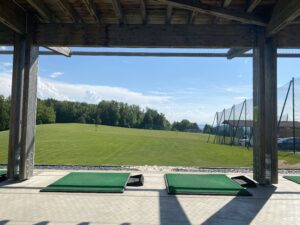
Since the golf practice in Annecy At Golf du Belvédère, with its multi-level layout and 230-meter covered area, you can use this plan regardless of the season. Visual markers and distances facilitate structured practice sessions rather than impromptu ones.
To progress faster with an outside perspective, Julien and Adrien, instructors at the Belvédère Golf School, build an individualized plan based on your actual level and personal goals, from the complete beginner to the experienced player wishing to refine their dispersion.
Are you a beginner at golf? Our guide How to start playing golf in Annecy details the first steps on the course and at the practice range.
Conclusion: Your next session in one sentence
Remember this simple structure for your next golf practice session: 15 minutes of short game, 20 minutes of wedges, 15 minutes of dispersion shots, and 10 minutes of course simulation, using the 5-ball rule and a consistent routine throughout the session. To learn more about the history and general rules of the sport, you can consult the page Golf on Wikipedia.
Want to put this plan into practice under the best conditions? Find all the information on the golf practice in Annecy of the Belvedere Golf Course, or contact our team to organize your next session.
FAQ: Golf driving range training: the plan to improve in 60 minutes
How long does a good golf practice session take?
Ideally, between 45 and 60 minutes: long enough to structure your short game, wedges, and full swing, but short enough to maintain your focus. If you only have 30 minutes, follow the same approach with proportional mini-blocks.
How to structure a 1-hour practice session?
Divide your time into 5 blocks: warm-up, putting and chipping, wedges, dispersion with irons and hybrids, then simulation "as if on the course". The most important point remains to set a single objective for the entire session.
How many balls should I hit on the practice range to progress effectively?
It's not the volume of balls that leads to progress, but the structure of the session. Aim for sets of 3 to 5 balls maximum, pause, adjust a setting, then change target or club.
Where to start at the practice range: the driver or the short game?
Always start with the short game and wedges, before finishing with the long clubs. This is the most effective way to lower your score and stabilize your tempo right from the start of your session.
Which exercise is the most effective for fine-tuning your wedges?
The distance scale, with three distances practiced and three balls at each, combined with an identical routine before each shot. This allows you to build reliable reference points rather than relying on a simple random feel.
How to transfer progress from the practice range to the course?
Always finish your session with 5 to 10 minutes of simulation, alternating clubs and targets as you would on a real hole. This format, closely resembling playing conditions, is what transforms training into actual points earned on the course.