Why play golf? 7 reasons to start (and how to get started in Annecy)
We play golf to get exercise without damaging our joints, to disconnect in nature, and to progress at our own pace. Why play golf? Because it's a complete sport—walking, coordination, core strengthening—that can be played alone or in a group, from childhood to old age, with short formats compatible with a busy schedule.
Expert advice: Before multiplying sessions without a method, book a free introduction: in one hour it lays down reference points (grip, posture, safety) which will save you several weeks of progress.
Table of Contents - Why play golf? 7 reasons to start (and how to start in Annecy)
The 7 real reasons why you should play golf (the ones that make you stay)
1) Because your real opponent is yourself
Golf isn't won against an opponent, but against yourself. It's a sport that teaches you to manage your mistakes calmly, to stay focused after a bad shot, and to come back stronger. The detail that makes it addictive: a single good shot can be enough to save an entire round, and it's often the one you come back for the next time.
2) Because it's a complete sport disguised as a walk
Walking a course engages your core, balance, and coordination, without ever feeling like you're "doing sport" in the traditional sense. A University of Edinburgh study involving tens of thousands of golfers established a link between regular golf practice and a life expectancy extended by several years, thanks in particular to the cardiovascular benefits of prolonged outdoor walking.
- A gradual effort, easier to maintain over time than a high-intensity sport.
- Suitable for many physical levels and age groups.
- A short format of 45 to 60 minutes at the practice range is already enough to reap the benefits.
3) Because it is an effective and measurable stress reliever
On the course, attention is captured by a succession of micro-decisions: club selection, reading the trajectory, breathing, alignment. This mechanism naturally leaves less mental space to dwell on everyday worries. Most players report feeling calmer after leaving the course, even after a technically disappointing round—disconnecting from the game often takes precedence over the score.
It is no coincidence that more and more people with intense professional activities are turning to golf rather than a more cardio sport: the duration of a round (one to two hours for a 9-hole course) imposes a clear break from screens and usual demands, without requiring the energy of an intensive workout after a long day of work.
4) Because it's social, without being intrusive
Unlike sports involving direct competition, in golf you play with your partners against the course, not against each other. You chat between shots, share a ride in a golf cart or a short walk between holes, without the "mandatory outing" aspect of some group activities. And if you prefer to practice alone, that's perfectly fine too.
5) Because you can progress quickly by starting well
Golf becomes frustrating when you learn on your own, by trial and error. Conversely, a structured introduction followed by some technical guidance can save you several weeks of progress. That's the whole point of starting with... golf lessons in Annecy suitable for beginners, rather than multiplying attempts without a method.
6) Because it fits into a real-time schedule
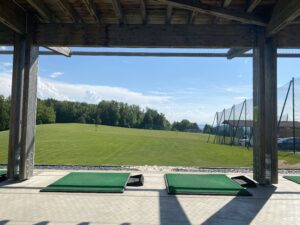
It's not necessary to block out half a day. Between a session at The driving range of 45 minutes and a 9-hole course, Completed in one and a half to two hours, there are short formats that fit a busy schedule.
| Format | Average duration | For whom |
|---|---|---|
| Practice session | 45 min – 1 hour | Work on your swing without pressure, lunch break included. |
| 9-hole golf course | 1h30 – 2h | Experience the full picture without spending the whole day there |
| 18-hole course | 4am – 5am | Classic format once you're comfortable with the game |
7) Because it's a fun outdoor activity that can be shared
The setting is a big part of the experience: fresh air, greenery, silence. Around Annecy, playing with a view of the mountains adds a dimension that few urban sports offer. After the game, it's common to continue the conversation over a drink at the Clubhouse.
What are the health benefits of golf?
Golf combines moderate, low-impact physical activity with continuous mental stimulation. On a course, a player walks several kilometers in a few hours, which maintains cardiovascular endurance without the repeated impact of a running sport. The swing engages the torso, shoulders, and legs with each shot, making it a core strengthening and rotational exercise repeated throughout a round.
On a mental level, the concentration required for each shot acts as an exercise in focused attention, often compared to a form of moving meditation. It is also a sport that can be practiced at almost any age: one can start in childhood and continue playing, simply adapting one's pace, well past 70 — a rare example of a sporting activity without a real upper age limit.
Is golf accessible to all levels and all ages?
Yes, and that's one of the reasons why this sport attracts more than 100 million players worldwide today, according to figures cited by the International Golf Federation. Unlike a team sport where each player's skill level directly impacts that of others, golf is played individually, even in a group: each player progresses with their own handicap system, allowing a beginner and an experienced player to share the same course without any imbalance.
This handicap system is one of golf's greatest strengths: it neutralizes the difference in skill level rather than highlighting it. Two players can thus have a close and fair match even if one hits the ball much farther than the other, simply because the number of strokes allowed compensates for the difference in technical ability. It's a mechanism that few other sports offer so naturally.
Equipment is not a barrier to getting started either. For a first session, shorts and sneakers are all you need: the Proshop This allows you to gradually acquire equipment, once your practice is confirmed, rather than blindly investing in a complete first bag.
And if you want to go further: discover the competition
Once the basics are in place, many golfers discover another aspect of the game: friendly competition. This doesn't necessarily mean ranked tournaments in the early months, but rather convivial formats — scramble, team stableford, internal club competitions — which allow you to play with other members in a motivating environment, without the pressure of a strict individual score.
This progressive format is often what makes a casual player switch to a more regular practice: the competition calendar provides a rhythm, a concrete objective for each outing, and an additional opportunity to meet the same group of players week after week.
Golf vocabulary to know before your first outing
You don't need to master all the golf jargon to get started, but a few pointers will prevent you from feeling lost from the very first exchanges with other players.
- Tee : the starting area of each hole, where the ball is placed on a small support for the first shot.
- Fairway : the strip of short-mowed grass between the tee and the green, the "ideal" area to land the ball.
- Green : the area of very short grass around the hole, where the final putt is played.
- Rough : longer grass at the edge of the fairway, more difficult to play.
- Bunker : a sand obstacle, to be bypassed or played with depending on the trajectory.
- Swing : the full stroke, used from the tee or from the fairway.
- Chip : a short approach shot, played close to the green to bring the ball closer to the hole.
- Putt : the stroke played on the green, with the putter, to roll the ball into the hole.
These few words are more than enough to follow a first introduction without feeling lost in front of more experienced players.
Golf, a sport followed by tens of millions of players
Golf is not a niche activity: today it has more than 100 million regular players worldwide, and competitions like the Ryder Cup are among the most followed international sporting events, broadcast in many countries over several days.
This global popularity translates locally into a constantly diversifying range of courses: seaside, mountain, countryside — each course offers a different playing experience, which explains why so many players continue to discover new courses year after year without ever getting tired of them.
Around Annecy and Haute-Savoie, this diversity is found on a smaller scale: a 9-hole course in the mid-mountains does not offer the same sensations as a links course by the sea, which makes it a good learning ground to understand the reading of slope and wind before, possibly, going to play elsewhere.
How to get started in golf: the 3-step plan
Step 1 — An introduction to lay the foundations
For a complete beginner, the fastest route remains a Introduction to golf in Annecy It allows you to acquire essential skills (grip, posture, safety) and avoid developing bad habits from the start. Equipment is provided; no investment is necessary for this first session.
At the Belvédère Golf School, these initial sessions are led by state-certified instructors—Patrice, Alicia, and Adrien—who are accustomed to welcoming complete beginners who have never held a club before. The goal of an introductory lesson isn't to leave knowing everything, but to leave with two or three solid foundations to build upon: correct posture, a grip that doesn't become a bad habit, and a clear understanding of what constitutes a clean contact.
Step 2 — The practice area, the zone for rapid progress
Then, 30 to 45 minutes of practice is enough to establish a routine: ten balls for a clean contact, ten balls towards a close target, ten balls with the same routine repeated (breathing, alignment, striking), then a few minutes of putting to work on distance and direction.
Step 3 — A 9-hole course to experience the game
It is on the course that strategy, emotional management, and the enjoyment of the game truly come into their own. 9-hole course, is often the most suitable format for a complete first experience: long enough to feel the game, short enough not to discourage.
Common objections (and honest answers)
«"I'm going to be terrible."» — like any beginner. But in golf, not playing well yet doesn't prevent you from having a good time: success is measured first in "good contacts", not in score.
«"I don't have any equipment."» — It's not necessary to have prior experience. Comfortable clothing and sneakers are sufficient for a first introduction, as equipment is provided on site.
«"It's too expensive."» — The budget depends mainly on the format chosen. A simple guideline: consult the 5-hole / 9-hole rates before committing to a full subscription.
«"I don't know the rules."» — no one expects a beginner to know all the rules from the first outing. They are learned gradually, over the course of several games.
Conclusion: Why not try it this week?
Playing golf means accepting a demanding yet accessible sport that combines gentle physical activity, stress management, and social interaction, without requiring any particular level of fitness to begin with. The word golf The term itself refers both to this individual sport and its playing field — a centuries-old discipline that continues to attract new players every year, beginners as well as experienced ones.
If you're interested, the best way to find out if golf is for you is to try it out for yourself. Book your free introduction to Belvedere Golf and test the practice area, the grip and the initial contacts, without obligation.
FAQ: Why play golf? 7 reasons to start (and how to start in Annecy)
Why play golf rather than another sport?
Because it is one of the few sports that can be practiced throughout one's life, with low joint impact, which combines physical activity, mental concentration and social life in the same moment, without direct physical opposition with an opponent.
How long does the first part take?
An introductory lesson usually lasts less than an hour. Once the basics are covered, a 9-hole round takes between one and a half and two hours to play, compared to four to five hours for a full 18-hole round.
Is golf a physically demanding sport?
It develops endurance through walking and core strength through the swing, but without the repeated impact of a running sport. This makes it suitable for ages when other sports become more difficult.
Can you play golf without being technically good?
Yes. The handicap system allows players of different skill levels to play together, and technical progression is part of the fun of the game, not a prerequisite to start.
Do you have to be athletic to take up golf?
No. The intensity is progressive and adaptable: a first session at the practice range is enough to assess your sensations before considering a full round.