Introduction to golf: the complete guide to getting started without stress
A golf initiation session is a discovery session of approximately 1 to 2 hours, led by a certified instructor, which allows you to learn the basics (club grip, posture, first shots) without personal equipment and without obligation. The goal is not to "play well," but to understand the game and to know, in a single session, if this sport is right for you.
Expert advice: Come without any performance expectations: the first twenty minutes are only for finding a comfortable grip and contact, not for hitting far.
Table of Contents - Introduction to Golf: The Complete Guide to Getting Started Without Stress
What exactly is an introduction to golf?
An introductory session is quite different from a private lesson or a training course: it's an entry point designed for complete beginners, with no prerequisites. In a small group (often 6 to 8 people) or individually, depending on the organization, an instructor teaches the essential techniques—grip, posture, simplified swing—before letting each participant hit their first balls on the driving range.
Contrary to the image of golf as an elitist and highly codified sport, introductory lessons are specifically designed to defuse this apprehension: no one expects a perfect swing from the very first shot, and the instructors normalize mistakes rather than penalizing them. This is also what distinguishes a good introduction from simply having free access to the driving range: the presence of an instructor who provides real-time corrections prevents the development of bad habits from the very beginning.
The benefits of an introduction, beyond the swing
An introduction to golf isn't just about learning the technical aspects. For many beginners, it's also a true escape: golf imposes a calm rhythm, focusing attention on a single movement at a time, far removed from notifications and the fast pace of daily life. Many leave their first session physically tired, but mentally refreshed—an effect often unexpected for those who thought they were simply coming to "try out a sport.".
It's also a format that can be experienced in two different ways depending on the person: in a social setting, with several people, sharing and laughing between each move; or in a more solitary mode, focused on one's own progress, without the obligation to constantly interact with the rest of the group. Both approaches are equally valid, and the instructor generally adapts to the atmosphere of the group present that day.
What happens during an introductory golf session?
The format varies from club to club, but generally follows a four-stage progression over approximately one hour.
0-10 minutes: Welcome and initial contact
The instructor will assess your skill level, your expectations, and any potential physical limitations. The framework is established from the outset: no performance is expected, the focus is on comfort and discovery. This is also the time when you will be shown the equipment provided and the basic safety rules for the practice area.
10-25 minutes: initial movements (grip, posture, simplified swing)
You learn to hold the club loosely and to adopt a stable stance with your feet shoulder-width apart. The instructor usually has you repeat the swing several times without hitting the ball before introducing it, so that the movement is memorized without the pressure of the result.
25-45 minutes: practice, ball hitting
The session continues with short strokes to feel the ball-club contact, then progressively longer strokes as the swing stabilizes. It's often at this stage that the first "pleasant surprises" occur: a clean contact, a ball that takes off, a trajectory that straightens.
45-60 minutes: putting and practical application
Putting often concludes the session, as it's the most accessible and rewarding exercise for a beginner: it requires less strength, more precision, and provides a real taste of playing on the green. Some facilities add a short practice session on a few holes or a social gathering at the end of the session.
Do I need any special equipment or clothing to get started?
No, and this is one of the most frequent—and most unfounded—obstacles for beginners. For an introduction:
- Comfortable sportswear is sufficient, no need for "golf-core" attire.
- Stable shoes, like sneakers, are perfectly suitable.
- A cap and water are useful if the session takes place outdoors in hot weather.
In the vast majority of cases, clubs and balls are provided by the club. Therefore, you don't need to buy anything to try them out, and it's even advisable to wait several sessions before investing in your first set, to allow time to determine which club size truly suits your swing.
The basic techniques covered during the introduction
A good introduction is not limited to "hitting balls": it lays the fundamentals which later prevent the most common bad habits among self-taught golfers.
The grip
The way you hold the club determines the entire swing: a grip that's too tight restricts clubhead speed and disrupts the trajectory. The instructor demonstrates a relaxed grip, with hands aligned under the club, so that speed is generated through the swing itself rather than through finger tension.
The posture
Feet shoulder-width apart, knees slightly bent, torso inclined from the hips: a stable posture also protects the back, which can be sensitive from the very first sessions if the movement is not properly executed. This is a point the instructor often emphasizes, as correct posture facilitates almost all other learning.
The alignment
This is the direction your body—not just the club—is actually pointing. A good number of balls that go "right" or "left" for a beginner are due to poor alignment rather than a swing flaw per se.
The tempo
The beginner's reflex is often to want to hit hard. However, in golf, a regular and well-rhythmed movement produces better results than a rushed stroke — this is one of the most frequent surprises at the end of a session, when balls hit "softly" end up going further than those hit with force.
The club used to start
For the first few shots, the instructor usually suggests a mid-iron (7 or 9 iron) rather than a driver. This choice is not insignificant: these clubs have a more open face, which naturally helps the ball launch, and a shorter shaft, making them easier to control for the first contact. The driver, longer and requiring more precision, is generally only introduced in later sessions, once the basic stroke has been mastered.
Introductory course, private lesson or workshop: what's the difference?
These three formats meet different needs, and it is useful to distinguish between them before committing to one or the other.
| Format | Duration | Objective |
|---|---|---|
| Introduction to golf | 1 to 2 hours, only once | Discover the sport and find out if you like it |
| Regular group classes | Weekly sessions | Progressing step by step on the fundamentals, within a group dynamic |
| Individual lessons | À la carte | Working on a specific point (swing, putting, trajectory control) |
| Clinics | Several consecutive days | Progress quickly through intensive and focused practice |
In the vast majority of cases, initiation remains the first logical step before choosing one of these progression formats, once the desire to continue is confirmed.
Do you need to be athletic to get started?
No. Golf adapts to everyone's age, skill level, and physical condition. The effort is adjustable: minimal walking during an introductory lesson, short swings at the start, and an instructor who adjusts the distance and pace to your comfort. It's a sport that welcomes complete beginners as well as adults returning to physical activity after a break, each at their own pace.
How much does a golf initiation cost?
The price depends on the club and the chosen package. Some academies offer free introductory sessions regularly, often outside of peak periods. Others charge a trial package, generally around €10 to €20 depending on the region, equipment included. In all cases, the goal remains the same: to try the sport before investing in equipment or a year-long membership.
The most common mistakes at the beginning of learning
To avoid: wanting to hit hard from the first few balls, looking at the result of the shot before even finishing the movement, or gripping the club harder and harder with each failure.
These three reflexes are normal, but they perpetuate a cycle of frustration: the tighter the grip and the more rushed the movement, the less direct the contact. The teacher's role is precisely to break this cycle by focusing attention on one point at a time—the grip, then the posture, then the tempo—rather than correcting everything simultaneously.
Introduction to golf in Annecy: where to start near the lake?
Visit The Belvédère Annecy Golf Course, In Saint-Martin-Bellevue, a few minutes from Annecy, golf initiation is offered free of charge every Sunday from April to October, supervised by a state-certified instructor from the Belvédère Golf Academy (Patrice, Alicia or Adrien depending on the time slots).
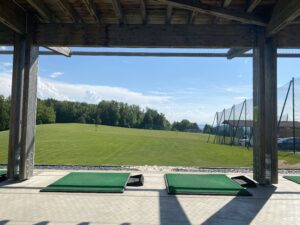
The session takes place on the Belvedere practice, The club boasts a unique 250-meter, two-story driving range, the only one of its kind in the region, with panoramic 360° views of the mountains and valley—a setting that offers a refreshing change from the typical urban driving range. Once the basics are mastered, the club's 9-hole course allows players to quickly put their introductory lessons into practice, without having to wait until they are "ready" for a full 18-hole round.
This 9-hole format is also a real advantage for beginners: the round is over faster, the walk is shorter, and it's easier to play several times a month to solidify the progress made during the introductory session. If the loaned equipment inspires you to take things further, the club's Pro Shop also offers guidance in choosing your first set of equipment suited to your swing, rather than buying at random.
What is the best time of year to start playing golf?
Most clubs offer outdoor introductory sessions from spring to autumn, the period when conditions are most comfortable for a first experience with the sport: dry grass, long days, and pleasant temperatures that allow for concentration for several tens of minutes. Spring remains the most popular time, reflecting a desire to resume outdoor activity and the prospect of enjoying the course all summer if the introductory session is successful.
That said, there's nothing stopping you from discovering golf outside of this window: many clubs have covered practice areas, usable even in the rain, to work on your grip and contact without depending on the weather. The essential point remains the same regardless of the season: choose a time when you're not pressed for time, to fully enjoy learning without the stress of a time constraint.
After the initiation, what is the logical next step?
A successful introduction to the sport ends with a clear direction, not with the pressure of "knowing everything". In practical terms, the realistic goal after a session is to hit a ball consistently, understand your most frequent mistakes, and want to come back — not to leave with a perfect swing.
Two main options emerge for what comes next: regular introductory courses In small groups, to consolidate the basics at your own pace, or with individual coaching if the goal is to progress more quickly on a specific point. The green card, which certifies that you can navigate a course independently, is generally only considered after several sessions: it is not the objective of the initial training, but a natural step once the fundamentals have been mastered.
Conclusion: Initiation, the smartest test
Taking a golf initiation lesson remains the quickest and least demanding way to find out if the sport is right for you: no equipment to buy, no performance pressure, and an instructor who adapts the session to your level. It's also an opportunity to demystify a sport often perceived as codified and elitist—as illustrated by the history of golf. golf, originating in Scotland as early as the 15th century as a popular practice, long before becoming the sport we know today.
Want to try it out for yourself? Golf du Belvédère organizes free introductory sessions every Sunday morning near Annecy — head towards the Golf School page to reserve your time slot.
FAQ: Introduction to golf: the complete guide to getting started without stress
Is it possible to attend an initiation alone, without knowing anyone?
Yes, that's actually the most common situation. The groups bring together beginners who don't know each other at the start, and the atmosphere is deliberately kept relaxed so as not to add social pressure to the technical learning process.
What is the minimum age to participate in an introductory session?
It depends on the facilities, but most welcome children from 6-7 years old for supervised programs, and there is no maximum age limit for adults.
Is it possible to do two introductory courses in the same month to progress faster?
Yes, there is nothing wrong with repeating the experience before committing to a more regular course format: this allows you to confirm your desire and better retain the basics.
Is an introductory session enough to then play alone on a course?
No, not directly. The initiation lays the foundations of safety and technique, but autonomy on a course generally requires several additional sessions, validated by an instructor.
What if you can't touch the ball during the first few minutes?
This is very common and part of the normal learning process. The teacher will then adjust your posture or grip rather than letting you persist with a movement that isn't working.